MENU

Sections

  • Home
  • About
    • The Chestertown Spy
    • Contact Us
    • Advertising & Underwriting
      • Advertising Terms & Conditions
    • Editors & Writers
    • Dedication & Acknowledgements
    • Code of Ethics
    • Chestertown Spy Terms of Service
    • Technical FAQ
    • Privacy
  • The Arts and Design
  • Local Life and Culture
  • Public Affairs
    • Ecosystem
    • Education
    • Health
  • Community Opinion
  • Donate to the Chestertown Spy
  • Free Subscription
  • Talbot Spy
  • Cambridge Spy

More

  • Support the Spy
  • About Spy Community Media
  • Advertising with the Spy
  • Subscribe
November 14, 2026

ARCHIVE Chestertown Spy

Nonpartisan and Education-based News for Chestertown

  • << RETURN TO CHESTERTOWN SPY
  • << RETURN TO CHESTERTOWN SPY
Arts Looking at the Masters Spy Journal

Looking at the Masters: Charles Burchfield in Autumn

October 23, 2025 by Beverly Hall Smith

Charles Burchfield (1893-1967), born in Ashtabula, Ohio, has been associated with American Modernism, but this category does not begin to capture the scope of his watercolor paintings. They are in the collections of more than 100 museums in America and Europe. He was a visionary whose love of nature in every season, time of day, and condition inspired his unique paintings. Autumn is upon us, and Burchfield shares his response to the season through his watercolors and journal entries.

“Autumnal Wind and Rain’’ (1915)

Burchfield began his journal in junior high school. He was determined to record all the flowering plants in Salem, Ohio, where he grew up. “Autumnal Wind and Rain’’ (1915) (14’’x20’’) (watercolor) is an early work that concentrates on the shapes of leaves blowing in the wind. White streaks are painted across the leaves. The viewer might think at first the white streaks are a depiction of rain. However, the hazy yellow sky in the background gives no indication of a storm. A simple compositional device, two green spots of paint in the foreground anchor the image, and the red paint at the right also holds the composition steady. The group of light gray towers to the right suggest a town beyond the trees. Another area of light gray painted in the middle ground also suggests the presence of a building with two windows. This early painting is simple, subtle, and effective. In a journal entry dated October 21, 1914, Burchfield commented on the piece: ‘’The third of wonderfully fair October days.  My heart seems ever on the point of bursting with the beauty of this autumn.  It is a golden age. All my thoughts seemed touched with the golden atmosphere.” In 1915, he wrote, “My diary seems to be a journal of the wind, sunshine and sky.” He was “gathering the materials for a lifetime.” 

Burchfield did not write about the influence of other artists on his style; however, in “Autumnal Wind and Rain’’ and other early works there is an oriental tendency. He worked as a guard at the Hatch Galleries in Cleveland in 1914. He saw an exhibition of Chinese scroll paintings. He wrote that he would “execute, in a continuous form, the transitions or sequence of weather events in a day, or several days or seasons.” These he called “all-day sketches” and there is a sense of sequence to the painting of the leaves. 

Burchfield graduated from the Cleveland Institute of Art in 1916, and he received a scholarship to attend the prestigious National Academy of Design in New York City. After just one day in a life drawing class, he left. In his early work, he had developed his own watercolor technique using washes, black ink for opaque areas, and white gouache, not acceptable in traditional watercolor. He used dry-brush watercolor on paper that stoop upright like a canvas on an easel. His unique technique would continue, but his subject matter broadened to include architecture.  Burchfield served in the army, applying his painting skills to camouflage tanks and artificial hills. He was honorably discharged in 1919. 

Burchfield married Berthe Kenreich in 1922. They had five children. The family moved to the rural neighborhood of Gardenville in West Seneca near Buffalo, New York. He was represented in 1928 by the Frank Rehn Gallery in New York City. Edward Hopper, Reginald March, and Bradley Tomlin also were represented by the Gallery. From 1928 onward, he was able to support his family by making art. The Museum of Modern Art exhibited his watercolors in 1935. In that same year his work was included in the International Exhibition of Paintings at the Carnegie Institute in Pittsburgh. Also in 1935, Life Magazine named him one of the ten most important American painters.

“Wind Scattered Leaves” (1944)

As Burchfield’s paintings developed, he added a wider landscape that included nature in all its moods. “Wind Scattered Leaves” (1944) (20”x25’’) is a depiction of autumn. Orange and yellow leaves are spread below the trees. Fields in the distance transition from bright greens to dusty brown and other pale colors. Evergreens provide contrast with the black trunk of a nearby tree in the foreground. Farther off, a dull gray-green and tan bush, still holding its leaves, is a reminder that winter approaches. Some of the black leaves higher in the sky could double as crows. Some of the leaves in the right foreground are painted with sharp brush points to depict the dryness of the season. Burchfield noted, “Most of the leaves are down, dried & pale-yellow brown but here & there some glowing red ones. A puff of wind scattered the leaves along the surface and they caught the sunlight with little halos around them.”

“Wind Scattered Leaves” (1944) (detail)

A look at the application of the paint in “Wind Scattered Leaves” reveals Burchfield’s technique of overlapping brush-strokes of color. The energy can be seen. He was a master of watercolor, considered to be the most difficult of medium. 

“Autumnal Fantasy” (1944)


“Autumnal Fantasy” (1944) (37”x53”) displays another aspect of Burchfield’s painting. From the beginning his fascination with nature and with Transcendentalism, developed in New England in c.1836 and promoted by authors Henry David Thoreau and Ralph Waldo Emerson, among others. Burchfield held the belief that God and nature are the same, and through intuition, emotion rather than reason, and being in nature the individual can experience the divine.  In the painting, repeating and swirling lines of paint are used the depict earth and water. Tree bark is painted with distinct and detailed patterns. 

The sunlight is painted with a mystical golden glow. The sounds of bugs and birds in the woods are created by rows of black semi-circles coming from various parts of the woods. Burchfield wants viewers to experience all of the senses–sight, sound, taste, smell, and touch–as he does.  At the end of his life, he asked, “Will I ever truly be able to express the elemental power & beauty of God’s woods?”

“Autumn Storm” (1948)


In “Autumn Storm” (1948) (26’’x40”), Burchfield captured another of nature’s moods, with dark clouds of a coming storm. The clouds cast the earth beneath them in darkness. The skeletal trees bend in the wind, and the dry grasses seem to quiver as the storm approaches. Burchfield’s journal reports many such experiences: “I spent some time wandering around in the woods trying to find just the right spot to carry out my idea, which has obsessed [me] for some time (the lynx woods giving the feeling of the coming of winter into the glory of autumn).” (October 17,1956) Later, he wrote, “In the north, gigantic thunderstorms were slowly moving eastward, constantly swelling upward and changing form–breath-taking sight, with such pure white tops, and never getting much darker…” (September 1, 1962) 

Burchfield was elected in 1954 to the National Academy of Design in New York. The prestigious honorary association was organized “to promote the fine arts in America through instruction and exhibition.”. He also was elected in 1958 to the American Academy of Arts and Letters, and received a gold medal in an exhibition in 1960. During that period, he began to experience problems with his health: rheumatoid arthritis in 1955 and a heart attack in 1963.

“October Outside” (1963)

Burchfield painted “October Outside” (1963) (39”x27’’) indoors. He continued to paint no matter his health. The viewer sees a well-weathered wood door with several decorative panels and a glass window. The outdoor scene is reflected in the window. The pickets of the fence cast green shadows across the lawn. A green pot is set on a plant stand. The black tree trunk is topped with orange, red, and yellow leaves. Burchfield suffered a fatal heart attack in 1967. He was in the yard of his home, working on a painting to be titled “Early Spring.”

The Charles Burchfield Center at Buffalo State College was dedicated to the artist in 1966. It was renamed The Burchfield Art Center in 1983 with a mission to support various artistic pursuits.  It became the Burchfield Penney Art Center between 1991 and 1994, when Charles Rand Penney donated 1,300 works by New York artists, including 183 by Burchfield. A 29-acre art and nature complex in West Seneca, New York, was named for Burchfield in 1992. 

Near the end of his life, Burchfield expressed the sentiment, “How slowly the ‘secrets’ of my art come to me.” 


Beverly Hall Smith was a professor of art history for 40 years. Since retiring to Chestertown with her husband Kurt in 2014, she has taught art history classes at WC-ALL and the Institute of Adult Learning, Centreville. An artist, she sometimes exhibits work at River Arts. She also paints sets for the Garfield Theater in Chestertown.
The Spy Newspapers may periodically employ the assistance of artificial intelligence (AI) to enhance the clarity and accuracy of our content.

Filed Under: Looking at the Masters, Spy Journal

Food Friday: Easy Bake

October 17, 2025 by Jean Sanders

Now that the threat of the nor-easter has swept past us, and there are cooler, clearer days ahead, we seem able to prepare for autumn. I have a new copse of trees out my window – no more dramatic pecan orchard swinging its loose limbs with abandon. Instead I look out at tall, skinny birches and long-legged long-needled pines. Some of their leaves are turning yellow and gamboge as they glisten and sway with dappling light, shuffling cards and dancing in place. I don’t see many of the opportunistic squirrelly boys we had patrolling the orchard, but this weekend I did see a merry band of bluebirds, joyously celebrating their farewell tour. The changes are slow-moving as we wait for summer to finally depart, and for the cool breezes of fall to waft over our fevered brows.

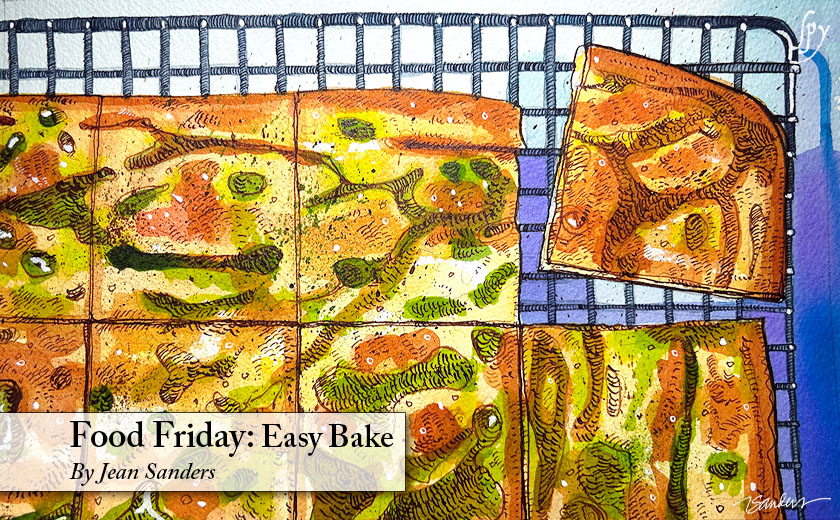
It’s time to do some easy baking; baking that delivers deliciousness for our minimal investment of time (and skill). It’s time for focaccia. Which is sublime when hot from the oven. It is good warm, it freezes well, and can be eaten for any meal. It is deeply satisfying to bake something warm and oozing olive oil and garlic – without all the bother of sour dough starter maintenance that found its way onto every homebound COVID-19 survivor’s to-do list.

Focaccia can be mixed up after breakfast, and ignored until an hour before dinner. Or you can make the dough after watching the Slow Horses, letting it rise over night, to be put it in the oven the next day. Yet, if you are suddenly seized with the yen for warm, home-baked bread, you can start the dough at lunch and hurry it along through the afternoon, and start baking in time for cocktail hour.
The Practical Kitchen We spent this past week experimenting.

Years ago I found a mix for focaccia at our local IGA market and it was a revelation to someone who had grown up on Pepperidge Farm white bread, Levy’s Jewish rye bread and the occasional loaf of freshly baked Italian bread from the red sauce Italian restaurant my family frequented for celebrations. I wasn’t used to warm and crusty, fresh, yeasty bread. During my European interlude I experienced the standard American food epiphany upon discovering baguettes, brioche, pain perdu, naan, crumpets, scones, hot cross buns, challah, pita, ciabatta, and finally focaccia di Recco col formaggio. Translation: my unformed suburban brain was blown.

Moving to the south brought me a deep appreciation for the simplicity of the biscuit. Upon moving further south (though considering Florida “south” is often debated, volubly) we found a wonderful French bakery, and we worked our way through their inventory of baked daily epi breads, baguettes, pain aux chocolate, croissants, and brioche. Jim and Kim’s bakery on Flagler Street in Stuart was deliciously aromatic, and educational.

This week our first batch of homemade focaccia was wrong in so many ways. The pan I used was too small, so the dough rose to epic, cornbread-y heights. Focaccia is considered a flatbread, or a hearth bread, not a voluminous soufflé. I also relied on the recipe, instead of my experience, and merely coated the pan with olive oil. What I should have done was use a larger, shallower pan, (thank you, Food52 for the sheet pan suggestion) and line it first with parchment paper, and then generously coat the parchment paper with olive oil.

The second batch was better, and more attractive. I dotted the dimpled top with halved cherry tomatoes, and a scattering of Maldon salt, finely minced garlic, and fresh rosemary. You can also consider decorating with cheese, basil, or onion. To bask in the glow of the Mediterranean, you could add lemon slices and green olives. For a more abundantly flavored focaccia you could add Prosciutto, mushrooms, green onions, and arugula. If you’d like something sweeter, for a breakfast dish, consider honey, apples, raisins, raw sugar, orange peel or lemon zest.
I aspire to baking airy, crisp baguettes, and hope in time I will master some of the necessary skills. In the meantime, I am content to have spent a week learning about the simple goodness of focaccia. In these perilous times, it is good to ratchet down some of the anxiety with soothing oozy, warm, crunchy, garlicky goodness. And with the stash in the freezer, it is always close at hand.

Taste Atlas

Bon Appétit

Food52

These are easy – you can start after lunch and have tasty, fresh, piping hot focaccia for dinner. My favorite part was poking the little dimples into the dough after it has risen. And then artfully scattering the rosemary leaves, which I picked from the plant running wild in the container garden. (The rosemary plant has thrived outside even through the past two winters. It is an amazement to me.)

I just loved baking a version of focaccia in our trustworthy cast iron skillet. I’m adding it to the list of good foods that can be prepared in just one pan – always a plus in my book because most of the time I am the designated dishwasher. It was crispy and crusty and tasted divine dipped in a small saucer of olive oil and garlic, salt, pepper, dried oregano and basil. It is practically a meal unto itself. Add salad and wine, and if you are being really pesky, a protein. Mr. Sanders and I gobbled up half a pan, which left half a pan to go in the freezer, that we hauled out delightedly a few nights later. Food in the freezer = money in the bank and less prep time. More time to paint the back porch, or weed the lettuce bed, or watch the blue birds soar through the shimmering, pointillistic autumn leaves.

Skillet focaccia

“The smell of good bread baking, like the sound of lightly flowing water, is indescribable in its evocation of innocence and delight…”
—M.F.K. Fisher


Jean Dixon Sanders has been a painter and graphic designer for the past thirty years. A graduate of Washington College, where she majored in fine art, Jean started her work in design with the Literary House lecture program. The illustrations she contributes to the Spies are done with watercolor, colored pencil and ink.

The Spy Newspapers may periodically employ the assistance of artificial intelligence (AI) to enhance the clarity and accuracy of our content.

Filed Under: 1 Homepage Slider, Food Friday, Spy Journal

As the Supreme Court Term Begins… Some Reflections by Margaret Andersen

October 3, 2025 by Opinion

As the U.S. Supreme Court begins its new term and at a time when public confidence in all national institutions, including the Supreme Court, is at an all-time low, I am heartened by remembering how one letter, sent long ago to Associate Justice Harry Blackmun, can remind us of the heart beneath a justice’s robe, even at a time when a justice was under vicious attack by political opponents. I am also reminded of what it can mean to bring joy to a justice’s chamber. And I am thinking about my long-gone dogs. 

I named my two dogs, who were abandoned as puppies by their owners, after Justices Thurgood Marshall and Harry Blackmun, two giants in judicial history. Thurgood Marshall, the first African American to serve on the Court (appointed in 1967), was touted for his long-standing commitment to civil rights, including early cases that prohibited racially restrictive real estate covenants. In another of his decisions, he invalidated the white primary, long a method by which southern Democrats maintained their political power. He is, though, best known for arguing the landmark case Brown vs the Board of Education before the Supreme Court in 1954.  A staunch advocate for people who had too long been denied legal protections in the United States, Marshall retired from the Court in 1991 and died in 1993. 

Likewise, Associate Justice Harry A. Blackmun left an indelible mark on U.S. judicial history. Appointed to the Court by President Richard Nixon in 1970, Blackmun’s early decisions on the Court were most aligned with conservative justices. Over time, however, his decisions became more in tune with those of more liberal justices. He was passionate in this support for abortion rights and defended affirmative action. Writing in the 1978 Regents of the University of California vs. Bakke decision, allowing some consideration of race in university admissions but disallowing racial quotas, Blackmun wrote, “In order to get beyond racism, we must first take account of race. There is no other way. And in order to treat some persons equally, we much treat them differently.” 

Blackmun’s support for abortion rights was unyielding. The very week we adopted our dogs (in 1989), Blackmun wrote a scathing dissent on the case Webster v. Reproductive Health Services, the first Supreme Court case to chip away at the constitutional right to abortion established in Roe v. Wade. In his dissent, Blackmun wrote, “For today, the women of this Nation still retain the liberty to control their destinies. But the signs are evident and very ominous, and a chill wind blows.” 

How prescient that dissent—one of the reasons I so admired Justice Blackmun. How did two photos of my dogs ended up in Harry Blackmun’s papers housed in the Library of Congress? 

Very few dogs find themselves memorialized in the Library of Congress. Dogs included famous people, such as TV host Ed Sullivan, singer Billie Holiday, actress Joan Caulfield, and actor Jimmy Durante mostly own those. Also included are some photos of national dog show winners. The Library of Congress is the largest library in the world, housing documents that tell the history of the United States by documenting and preserving some of the nation’s most important records. These are treasured archives, a repository of national civilization and creativity.

The Library of Congress hardly seems a place where ordinary neighborhood dogs would be seen. I am not a celebrity, nor a Washington insider, nor have my dogs ever been in a competitive dog show. Yet, sure enough, my dogs’ photographs are included in the hundreds of boxes that archive the work of Supreme Court Associate Justice Harry A. Blackmun: Box 1445, Folio #9.

When my husband and I took in these puppies, the house next door to us was a concrete block shack, owned by a notoriously obnoxious absentee landlord. The tenants, seemingly living on the margins of poverty, absconded in the middle of the night, probably owing back rent and fearful of the landlord’s well-known violent temper. Left behind were the mother dog and four newborn puppies. A reclusive neighbor who lived in the woods across the street took in the mother dog, but the puppies were left to fend for themselves. One poor pup was hit and killed in the road. A second pup was adopted by a neighbor’s friend. Left behind were two little black lab puppies.

Even before the tenants fled, the two puppies had been frisky, though largely ignored by their owners. The puppies liked scampering around on the riverbank, occasionally falling into the Chesapeake Bay where our house is located. My husband would jump in our rowboat, row to their rescue, drag them out of the water, and bring them back home. Later, they never seemed to like water—odd since they were mostly black labs, though not purebreds.  

When the dogs’ owners fled, we took in the two puppies, thinking we could find a home for them. We already had two cats and never intended to add dogs to our household, certainly not two of them! We tried to find people who would adopt the two puppies, preferably as a pair because they were brothers. We considered posting a “free puppies” sign at the local market but rejected that plan when we heard that puppies so publicly advertised might be picked up by an unscrupulous puppy mill operator. 

Once they were living on our porch, we became very attached. After a few weeks of trying to find a new home for them, we relented and decided to keep them. Like other dog owners, we tried to find fitting names for our newly adopted pups. It was 1989. The nation was emerging from the Reagan years—a time when many hard-fought civil rights were being retracted. George Bush Sr. was the President. Roe v. Wade had established the constitutional right to reproductive freedom in 1973, but the movement to overturn Roe was simmering. As someone who was teaching university courses on racial and gender inequality, I was keenly aware of the backlash against women and people of color that our nation was facing. 

I told my husband that, given the times, we had to name these two dogs for men who had done something good for women. I had long admired U.S. Supreme Court Associate Justice Thurgood Marshall, then retired from the Court. Our two dogs became Blackmun and Marshall.

I often thought about writing to the two justices about their namesakes, but life was busy and I didn’t do it until 1994. Moved by Blackmun’s announcement of his pending retirement, my husband and I drafted a letter to Justice Blackmun explaining why our dogs bore his and Thurgood Marshall’s names. The letter we sent, signed by my husband, included two pictures of the dogs together on our front lawn.

Our letter said:  

I didn’t really expect a response, but only a few days later, and much to our surprise, a letter on embossed Supreme Court stationery showed up in our mail! Written with wry humor, the grace of a gentleman, and with a subtle reminder of his positions on conception, Blackmun’s letter to us was hand-signed. 

We cherished that letter and our two amazing dogs, but life went on. Then, in 2004, things took an unexpected turn.

In honor of the fiftieth anniversary of the Brown v. Board court decision, the University of Illinois College of Law, like many academic institutions that year, sponsored a symposium about the impact of the Brown decision and invited me to present a paper. I gladly accepted and wrote an article on the implications of the Brown decision for different groups. I had presented many conference papers prior to this commemorative event. Still, I had never spoken at a law school or to a room packed with mostly law professors and other legal scholars. I am a sociologist. That is my usual audience. I was nervous and felt very out of my element. I knew no one on the featured panels and hardly anyone in the audience. But I knew my paper was solid, despite my anxiety about its reception. 

As I wrapped up my presentation, I thought it had gone well and considered adding that I had named my two dogs for the two justices I so admired. It seemed a little corny to bring up my dogs in such an esteemed and unaccustomed, for me, place, but oh well…I did it. The audience seemed to appreciate it. I sat down to a round of applause.

The next speaker was introduced as a law professor at Duke University. When she began her remarks, she expressed her appreciation for being with known colleagues and meeting new people…a common way speakers warm up their presentations. She then said, “And I am especially pleased to meet someone I have a special connection to…Maggie Andersen.” I was floored! I had never met her, did not follow her field of legal study, and could not imagine how she thought she knew me. She continued, “Years ago I was a clerk in Justice Blackmun’s chambers. One morning, he called all his clerks together because he had received a letter from ‘some professor in Maryland,’ and he wanted to share it with us. Treating his clerks to breakfast, he read the letter out loud.” She then said, directly to me, “You will never know how happy your letter made him!” She proceeded to deliver a very good analysis of the impact of the Brown decision on disability rights. 

As we sat at the symposium on Brown, the release of Blackmun’s papers to the Library of Congress was very much in the news. Blackmun had died five years earlier (in 1999) but had arranged for a quick release of his papers to the Library of Congress. His papers were released only five years after his death, which is unusual because most justices do not have their papers released until 50 years after their death. 

Because of the prominence of Blackmun’s papers in the daily news, I asked the former clerk if she thought our letter—and the photos of our dogs—would then be in the Library of Congress. She said, “No doubt! That’s how important your letter was to him.” As the session ended, she said she wanted to rush right out and call Justice Blackmun’s former secretary because she knew the secretary would be excited to know she had met me! 

I later learned, by reading Juan Williams’ excellent biography of Justice Blackmun, that at the time Blackmun received our letter, he was besieged by hate mail from those who strenuously objected to his more progressive opinions—particularly his defense of Roe. Our letter was a rare praise song!

Now, even more years later and with both dogs long gone, Blackmun’s fears have come to pass. More than a chill wind blows today. There is a full-blown hurricane toppling women’s rights, smashing civil rights, and crushing institutions themselves. The assault on reproductive rights is no longer directed at one man, but, rather, at entire institutions. Confidence in the judicial system, including the Supreme Court, has hit an all-time low, as has public faith in all national institutions. Even when under attack by the right, probably overwhelmed by case work, and fearful for women in America, Harry Blackmun found the time to pen a letter, honoring not only our dogs, but also the best of America: national institutions that adhere to American values, the cherished connection between public servants and citizens, and the protection of civil and constitutional rights of all Americans. How I long for the values and graciousness that Justice Blackmun demonstrated. My next dog, if a female, will be named Sonia. Or, should we acquire a litter, maybe Sonia, Ketanji, and Elena—women who are speaking truth to power. I miss Blackmun’s wisdom on the Court, and I miss my dogs.

With thanks to Patrick Kirwin, Manuscript Reference Librarian, Manuscript Division, Library of Congress and to Connie Cartledge, Senior Archivist, Library of Congress

Dr. Margaret L. Andersen is the Elizabeth and Edward Rosenberg Professor Emerita and Founder and Executive Director of the President’s Diversity Initiative at the University of Delaware, who resides in Oxford.

The Spy Newspapers may periodically employ the assistance of artificial intelligence (AI) to enhance the clarity and accuracy of our content.

Filed Under: Opinion, Spy Journal

Maryland Caucus Podcast with Foxwell and Corchiarino: Maryland’s Emerging Financial Perfect Storm

October 1, 2025 by Len Foxwell and Clayton Mitchell

Every Wednesday, Maryland political analysts Len Foxwell and Clayton Mitchell discuss the politics and personalities of the State and region. This week, however, Len is joined by Republican Queen Anne’s County Commissioner Chris Corchiarino to fill in for Clayton while he’s away on vacation.

This week, Len and Clayton discuss the combined political impact of Marylanders losing 28,000 federal jobs due to the Trump administration’s cost-cutting initiatives and an additional 5,000 to 10,000 workers out of work after today’s government shutdown at the same time the State anticpates a $3 billion shortfall in the next fiscal budget when Maryland’s Blueprint for Excellence public education plan will be requirign another $3 billion investment. They also share their “hot takes” for the week.

This video is approximately 13 minutes in length.

The Spy Newspapers may periodically employ the assistance of artificial intelligence (AI) to enhance the clarity and accuracy of our content.

Filed Under: Maryland Caucus, Spy Highlights, Spy Journal

Mark Dion and Alexis Rockman: Journey to Nature’s Underworld

September 27, 2025 by Anke Van Wagenberg


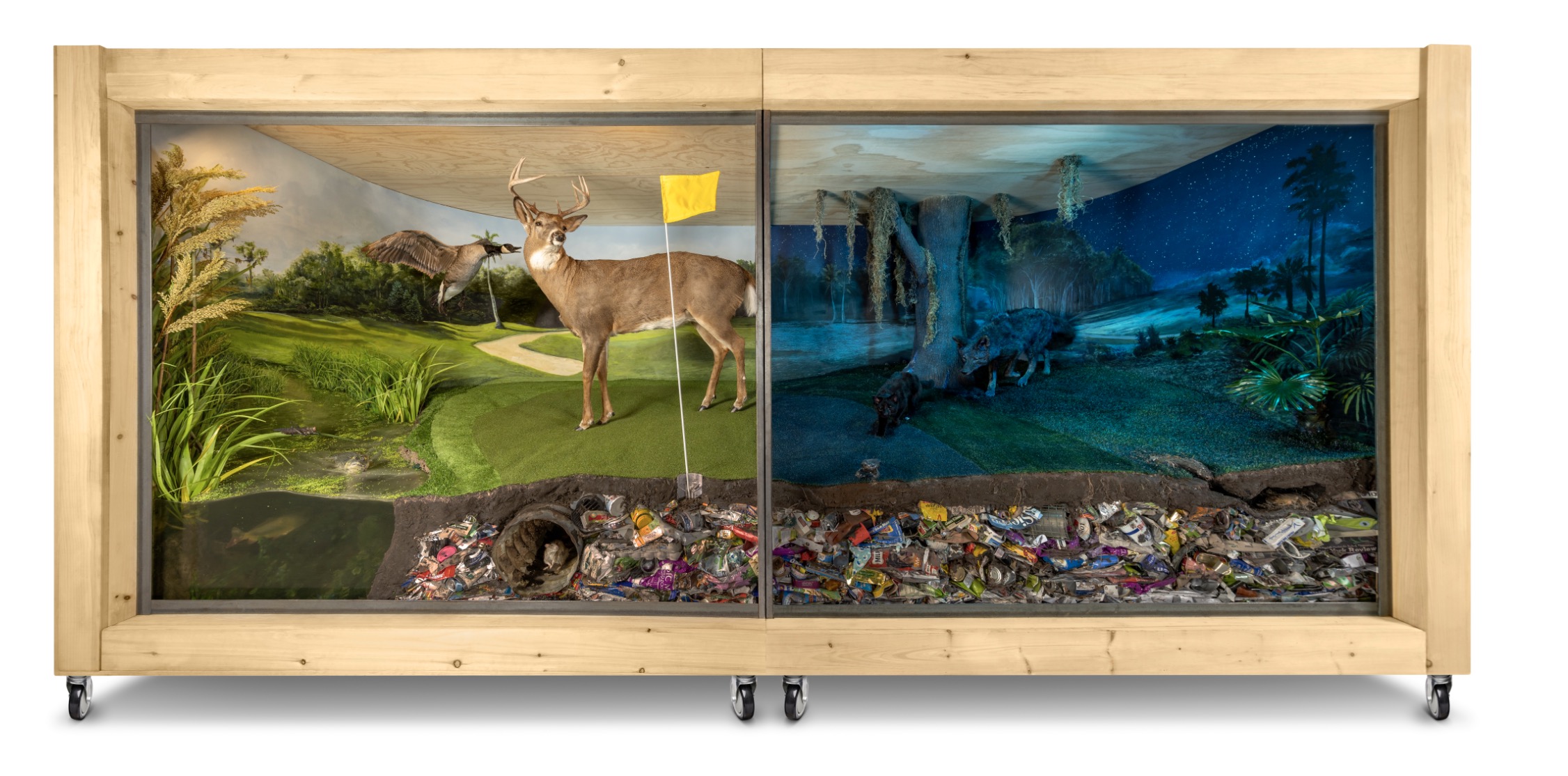
Mark Dion (1961) and Alexis Rockman (1962), American Landscape, 2022, Mixed-media diorama with taxidermy, found objects, and painted background, 96 x 192 x 87 in.. Courtesy of the artists

Such an honor to attend the opening (Sep 11, 2025) of Mark Dion and Alexis Rockman: Journey to Nature’s Underworld, at the Palmer Museum of Art at Penn State, University Park, PA. A beautiful installation of this AFA-organized exhibition! The first two-person exhibition of these celebrated artists, Mark Dion and Alexis Rockman: Journey to Nature’s Underworld explores their shared allegiances and sustaining friendship over a period of three decades. Dion and Rockman were among the earliest artists to address, and even anticipate, the epic ecological problems. Together, they have embarked on tropical expeditions; published dialogues; and co-edited the pioneering 1996 book Concrete Jungle, on anthropogenic ecosystems.

The exhibition will beget a voyage of discovery through various pressing subjects, with the artists’ works serving as enticing guides. Beginning with a section evoking the fieldwork of pioneering naturalists and explorers, visitors will encounter field-station tableaux by Dion alongside Rockman’s paintings of fauna and dramatic terrains, often with cross-sectioned views. Ensuing works will address such themes as invasive and endangered species, beleaguered aquatic environments, anthropogenic landscapes, and future scenarios evincing effects of climate change and waning biodiversity. An exhibition highlight will be the debut of a grand sculptural diorama, titled American Landscape, created especially for the tour and marking an unprecedented collaboration between Dion and Rockman.

This zoological group portrait, set on a golf course, will feature a cast of scrappy species that, according to the artists, successfully “exploit niches and opportunities generated by a human-transformed landscape” representing “the future global ecosystem.” The exhibition will also include a selection of related drawings and prints by both Dion and Rockman. In addition, participating museums will have the option of developing, along with the artists, an adjunct “Chamber of Wonders” display, conceived as a flexible cabinet of curiosities intended to inspire both awe and concern about the natural world.

The collaborative work American Landscape was created for the exhibition and commissioned by the American Federation of Arts.

On view from August 23 to December 7, 2025, at the Palmer Museum of Art at Penn State, University Park, PA. Organized by the American Federation of Arts, and after The Bruce, VAMoCA, The Tang, and The Lowe, this is the last museum partner in this successful tour.

Anke Van Wagenberg, PhD, is an art historian and serves as Senior Curator & Head of International Collaborations at the American Federation of Arts in New York, NY. She resides in Talbot County. 

The Spy Newspapers may periodically employ the assistance of artificial intelligence (AI) to enhance the clarity and accuracy of our content.

Filed Under: 1A Arts Lead, Spy Journal

  • 1
  • 2
  • 3
  • …
  • 14
  • Next Page »

Copyright © 2026

Affiliated News

  • The Cambridge Spy
  • The Talbot Spy

Sections

  • Arts
  • Culture
  • Ecosystem
  • Education
  • Health
  • Local Life and Culture
  • Spy Senior Nation

Spy Community Media

  • About
  • Subscribe
  • Contact Us
  • Advertising & Underwriting

Copyright © 2026 · Spy Community Media Child Theme on Genesis Framework · WordPress · Log in