
MENU

Sections

  • Home
  • About
    • The Chestertown Spy
    • Contact Us
    • Advertising & Underwriting
      • Advertising Terms & Conditions
    • Editors & Writers
    • Dedication & Acknowledgements
    • Code of Ethics
    • Chestertown Spy Terms of Service
    • Technical FAQ
    • Privacy
  • The Arts and Design
  • Local Life and Culture
  • Public Affairs
    • Ecosystem
    • Education
    • Health
  • Community Opinion
  • Donate to the Chestertown Spy
  • Free Subscription
  • Talbot Spy
  • Cambridge Spy

More

  • Support the Spy
  • About Spy Community Media
  • Advertising with the Spy
  • Subscribe
October 5, 2026

ARCHIVE Chestertown Spy

Nonpartisan and Education-based News for Chestertown

  • << RETURN TO CHESTERTOWN SPY
  • << RETURN TO CHESTERTOWN SPY
00 Post to Chestertown Spy Food and Garden Notes

Adkins Arboretum Mystery Monday: Guess the Photo!

November 24, 2025 by Adkins Arboretum Leave a Comment

Happy Mystery Monday! Can you guess what is pictured in photo #1?


The answer to last week’s mystery is the river birch, Betula nigra, pictured in photo #2.
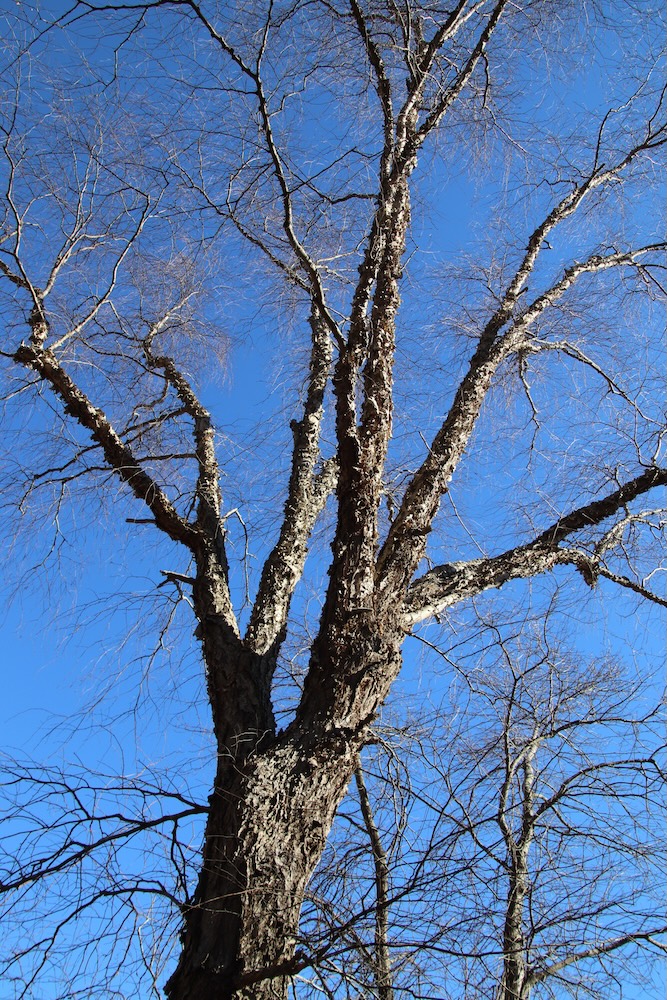
Found across the eastern and central United States, the river birch, Betula nigra, is the southernmost of all native birches, and the only one that naturally grows at low elevations. Its shimmering, peeling bark is one of its most recognizable features. This exfoliation is a natural process that helps the tree shed pests, disease organisms, and other hitchhikers like lichens, mosses, and fungi.

More heat-tolerant and disease-resistant than any other birch, the river birch thrives along streambanks, floodplains, and other moist sites where it helps stabilize soil and reduce erosion. In exceptionally dry conditions, river birch may drop some of its leaves as a water-saving strategy. In cultivation, it can be trained as a single trunk or a multi-trunked specimen—both forms showing off that distinctive bark.

The river birch is also notable for what it doesn’t suffer from: it’s the only North American birch naturally resistant to the destructive bronze birch borer. However, it is a “bleeder,” and pruning or accidental wounds cause sap to flow freely, attracting insects, some of which become stuck in the sticky drips. Late Spring flowering rounds out the appeal of this adaptable, resilient native tree.

Mystery Monday is sponsored by the Spy Newspapers and Adkins Arboretum.

The Spy Newspapers may periodically employ the assistance of artificial intelligence (AI) to enhance the clarity and accuracy of our content.

Filed Under: 00 Post to Chestertown Spy, Food and Garden Notes

Wine of the Week: Heba Morellino di Scansano DOCG from the Fattoria di Magliano

October 24, 2025 by Jennifer Martella Leave a Comment

Ciao Tutti!

This weekend at Piazza, we will taste a new wine, the “Heba” Morellino di Scansano DOCG  ($21.50, 13.5% ABV) from the Fattoria di Magliano in the Maremma area of Toscana. Morellino is the local name for the Sangiovese grape. Emily and I tasted this red wine with our rep and unanimously agreed it would be a great addition to Piazza’s collection. 

As an architect, I always look out for eye-catching label design like this wine’s image of an ancient Etruscan head that was found during a dig in the Pyrgi archaeological zone near the winery. In ancient Etruscan times, “Heba” was the name for the town of Magliano and connects the winery to its history in the Maremma region in this southern coastal area of Toscana. Each year when Firenze’s summer heat began, the Medici family escaped to summer homes in this southern coastal area of Toscana, even though malaria plagued the region. After several family members succumbed to malaria, Grand Duke Fernando I ordered drainage projects but it wasn’t until the 20th century that the area was fully drained. Now Maremma is once again sought after for its ancient ruins, beaches and hills.

The winery is located in a picturesque landscape with vineyards gently sloping down to the Tyrrhenian Sea, Giglio Island and Monte Argentario. The estate totals 97 hectares, 45 of which are devoted to viticulture in three vineyards including Magliano; the other 52 hectares contain the winery, agritourism facility, olive groves and woodlands. 

Fattoria di Magliano is a relatively young winery that was founded by Agostino Lenci in 1997,  when the footwear magnate  took a quantum leap to fulfill his dream of becoming a winemaker. His son Nicola is now co-owner. Lenci began planting the region’s signature indigenous grapes of Sangiovese and Vermentino in 1998 and other grape varieties soon  followed, as well as rave reviews by consumers and critics. After the winery transitioned to organic viticulture, it was certified in 2106. The wines are now grown from both indigenous and international grape varieties. Lenci’s son Nicola is now co-owner.

Fattoria di Magliano continues to evolve with renovation of the original estate cottage and a new building with 30 guest rooms, a swimming pool overlooking the Tuscan landscape, a restaurant where one can enjoy local cuisine and estate wines and a tasting room. 

“Heba” is 95% Morello and 5% Syrah, which results in a wine with bright cherry notes, concentrated fruit and soft tannins. Pair with pasta with  meat or vegetable ragu, Piazza’s cured meats, pizza or medium aged cheeses and roasted meats. 

Come join me Friday from noon to 5:45 or Saturday from noon to 4:45 for a delicious taste of Tuscany- 

Cin!

Jenn


Piazza Italian Market is located in the Talbot Town Shopping Center at 218 N. Washington St., suite 23, in Easton, MD

Contributor Jennifer Martella has pursued dual careers in architecture and real estate since she moved to the Eastern Shore in 2004. She has reestablished her architectural practice for residential and commercial projects and is a real estate agent for Meredith Fine Properties. She especially enjoys using her architectural expertise to help buyers envision how they could modify a potential property. Her Italian heritage led her to Piazza Italian Market, where she hosts wine tastings every Friday and Saturday afternoons.

The Spy Newspapers may periodically employ the assistance of artificial intelligence (AI) to enhance the clarity and accuracy of our content.

Filed Under: Food and Garden Notes

Adkins Arboretum Mystery Monday: Guess the Photo!

October 20, 2025 by Adkins Arboretum 1 Comment

Happy Mystery Monday! Can you guess what is pictured in photo #1?

The answer to last week’s mystery is the five-banded thynnid wasp, Myzinum quinquecinctum, pictured in photo #2.

The five-banded thynnid wasp, Myzinum quinquecinctum, is a solitary, late-Summer visitor to flowers across its range. With striking black and yellow bands, these wasps are often mistaken for yellowjackets—a helpful disguise that protects them from predators. Only the females can sting, and even then, they are virtually harmless unless handled.

Unlike social wasps, thynnids do not defend a hive. Females hunt larval scarab beetles, including Japanese beetles and May/June beetles. They use their stinger to paralyze their prey and, instead of dragging their prey away, they instead lay eggs on them where they are found. The males are slender and are often seen congregating on a single plant while the females focus on hunting.

During this time of year, their diet shifts from protein to carbohydrates (sugars), feeding on flower nectar. By preying on pest beetle larvae and visiting blooms for nectar, five-banded thynnid wasps play a quietly important role in our gardens and natural landscapes.

Mystery Monday is sponsored by the Spy Newspapers and Adkins Arboretum.

The Spy Newspapers may periodically employ the assistance of artificial intelligence (AI) to enhance the clarity and accuracy of our content.

Filed Under: Food and Garden Notes

Wine of the Week: Barbera d’Alba DOC from the Barale Fratelli Winery

October 17, 2025 by Jennifer Martella Leave a Comment

Ciao Tutti!

This weekend at Piazza Italian Market, we will taste the Barbera d’Alba DOC ($24.25, 14.5 ABV) from the Barale Fratelli winery in Barolo, Piemonte. Barbera is the every day wine of Piemonte and over the past years we have featured Barbera from other wineries. This Barbera has proven to be quite popular with our customers so it is long overdue for its debut at our wine tasting.

The Barale family traces its roots in Barolo back to the 16th century. They have been winemakers since the 1870’s, making them one of  Barolo’s oldest winemaking families. Their historic cellar is located in the Barolo Town Center and their thirteen hectares of eight vineyard sites grow Barbera, Dolcetto, Nebbiolo and Pinot Nero grapes, as well as Arneis and Chardonnay grapes.

The Barale family are serious organic farmers and I was impressed to learn they submitted 216 strains of native yeasts for molecular analysis to the University of Turin. They wanted  to determine which yeasts expressed the character of their unique terroir and narrowed their selection to the three best strains! 

The Barale family of father Sergio Barale and his daughters Eleonora and Gloria now manage the winery. In the future, Barale Fratelli (brothers) will become Barale Sorelle (sisters) that reflects the role of women in leadership roles in what was for generations a male dominated industry. Eleonora and Gloria respect and maintain the traditional  methods of viniculture while being open minded to modern technology.

The Barale Fratelli Barbera d’Alba has aromas of ripe red cherries, medium body, smooth tannins, with a flavor of tart cranberry-perfect for our mild fall days. If you have not yet tasted this wine, come join me on Friday from noon to 5:45 or Saturday from noon to 4:45 and you just might make this Barbera your everyday wine too!

Cin Cin!

Jenn


Piazza Italian Market is located in the Talbot Town Shopping Center at 218 N. Washington St., suite 23, in Easton, MD

Contributor Jennifer Martella has pursued dual careers in architecture and real estate since she moved to the Eastern Shore in 2004. She has reestablished her architectural practice for residential and commercial projects and is a real estate agent for Meredith Fine Properties. She especially enjoys using her architectural expertise to help buyers envision how they could modify a potential property. Her Italian heritage led her to Piazza Italian Market, where she hosts wine tastings every Friday and Saturday afternoons.

The Spy Newspapers may periodically employ the assistance of artificial intelligence (AI) to enhance the clarity and accuracy of our content.

Filed Under: Food and Garden Notes

Asters By Nancy Taylor Robson

October 14, 2025 by Nancy Robson 1 Comment

Bee on Georgia aster

The Kent County Master Gardeners’ first fall plant sale, which was a great success thanks to the enthusiasm and support of our Eastern Shore community, included some wonderful native plants shared from the gardens of the Master Gardeners themselves. (Gardeners are such generous souls!). There were also lush mums, which because they were field grown, will come back year after year when planted by those who gleefully hauled off the last of the 50 on offer.

One of the great things about a plant sale at this time of year is the opportunity – and reminder – to take inventory in our own spaces and see what’s missing or what could be enhanced. Often, it’s in the fall-blooming perennials. We tend to go bonkers in the beginning, but sorta peter out in late summer. Which robs us of the beauty of the new season and robs the pollinators, migrating, and soon-to-be-hibernating critters of critical fall sustenance. Which is unfortunate because there are so many great autumn options. Like Asters, which are the unrivaled stars of the third season.

“Asters are excellent for both the garden and pollinators,” says Melissa Starkey, PhD, an instructor at Mt. Cuba Center in Hockessin, DE.

Often called Michaelmas daisies since many varieties are in bloom during the feast of St. Michael and All Angels on September 29, Asters (whose name means ‘star’ in Greek) are wonderful bridges between the gradual exit of summer and autumn’s resurgent bloom. Depending on cultivar, they can carry on into November and provide food for months in a season that can otherwise be a pollinator food desert.

“They’re great host plants for caterpillars, including the Pearl Crescent Butterfly,” says Starkey. “Butterflies like Monarchs have the chance to get some food before their journey. And the bees who will be hibernating. And, of course, the seeds feed birds and small animals. That’s the benefit for wildlife: they provide food when there is not much going on in the garden.’’

Plus, Asters add wonderful color to the fall garden. New England Aster (Symphyotrichum novae-angliae), a sun-lover native to much of the Eastern Seaboard, tends to bloom in early September with lovely purple blooms that are usually mobbed with pollinators and butterflies.

Interestingly, plants that we usually call Asters are now classified as several different genera. (Thank you, taxonomists! I still remember the Chrysanthemum/Dendranthemum split of 15 years ago, which remains confusing – and annoying – for some of us).

Regardless of genera, from the average gardener’s perspective, it’s the wonderful combination of beauty, creature benefits, and bloom times that really matter. Some perennials give up after three weeks. Asters tend to take a licking and keep on ticking for 4-6 weeks. Meanwhile, the pollinators are being well supplied.

“They’re covered with butterflies and bees,” says Dale Foster, owner of An East Ridge Garden in Centreville. “All the different butterflies looking for food sources right now.”

Aster for shade: white wood aster

And they can be a one-stop shop for some pollinators.

“The thing about them is that what you see as one flower that looks like a daisy is many flowers put together,” says Starkey. “The Aster family used to be called the Composite family because it’s a composite of many flowers. A pollinator only has to land on one flower head, and they get access to so much pollen without having to travel. That’s why they are bombed with bees and butterflies – because they are so rich!”

For many years plantsmen have been creating Aster cultivars that extend the straight native bloom season and offer a wider range of color.

“You can have the early bloomers like New England [Aster],” says Starkey. “There are many cultivars of that. ‘Pink Crush’ which is magenta. ‘Grape Crush’ is a deep purple. There’s purple dome, which is a royal purple. There’s a Georgia Aster has really big flower heads, like two inches wide, and they bloom late. Mine are just getting a little purple and will open up next week. Even on the same plant at Mt Cuba there are some purplish and pink blooms every single year! And there are cultivars of ‘Twilight Sky,’ which is a Mt. Cuba introduction and is aromatic. It’s blooming from the last of October into November, and that’s really extending the bloom time,” says Starkey.

New England aster with pink and purple

While many Asters are true sun lovers, there are also White Wood Asters (Eurybia), a low-growing native, that offer white-starred splendor in dappled shade for weeks at summer’s end into fall and attract a variety of pollinators.

Mindful of the ‘straight native vs cultivar/wildlife benefit’ discussion, it’s hard to tell definitively without specific individual scientific research. But if the pollinators mob the plants, whatever the degree of benefit – the total protein content of a pollen grain for instance – it’s a whole lot more than a clear-cut, fall-cleaned-up landscape. And much more beautiful.

Mt. Cuba has trialed 56 different selections of Asters. You can download the report, which is worth going through, especially since it includes great images and descriptions.

And for those of us who love gardening but not high-maintenance, Asters are virtually carefree.

“The rabbits don’t bother them,” Foster notes. “Squirrels do not bother them because they have a scent that squirrels don’t like, and I’ve never heard of deer bothering the Asters much.”

Though some people (like me) let the tall varieties grow untouched all summer, Foster suggests giving them the ‘Chelsea Chop’ in late May-early June.

“Cut them down by about a third in early summer,” says Foster. As with many later-blooming perennials, this early pruning will encourage more stem and foliage growth that will produce more blooms in the fall. And Aster sare reliably perennial.

“Asters are surely coming back every year,” says Starkey. “They benefit wildlife, and your garden, and they’re beautiful. They’re win-win.”

Longtime journalist, essayist, and garden writer Nancy Taylor Robson is also the author of four books: Woman in The Wheelhouse; award-winning Course of the Waterman; A Love Like No Other: Abigail and John Adams, a Modern Love Story; and OK Now What? A Caregiver’s Guide to What Matters, which she wrote with Sue Collins, RN.


The Spy Newspapers may periodically employ the assistance of artificial intelligence (AI) to enhance the clarity and accuracy of our content.

Filed Under: Archives, Food and Garden Notes

  • 1
  • 2
  • 3
  • …
  • 58
  • Next Page »

Copyright © 2026

Affiliated News

  • The Cambridge Spy
  • The Talbot Spy

Sections

  • Arts
  • Culture
  • Ecosystem
  • Education
  • Health
  • Local Life and Culture
  • Spy Senior Nation

Spy Community Media

  • About
  • Subscribe
  • Contact Us
  • Advertising & Underwriting

Copyright © 2026 · Spy Community Media Child Theme on Genesis Framework · WordPress · Log in