MENU

Sections

  • Home
  • About
    • The Chestertown Spy
    • Contact Us
    • Advertising & Underwriting
      • Advertising Terms & Conditions
    • Editors & Writers
    • Dedication & Acknowledgements
    • Code of Ethics
    • Chestertown Spy Terms of Service
    • Technical FAQ
    • Privacy
  • The Arts and Design
  • Local Life and Culture
  • Public Affairs
    • Ecosystem
    • Education
    • Health
  • Community Opinion
  • Donate to the Chestertown Spy
  • Free Subscription
  • Talbot Spy
  • Cambridge Spy

More

  • Support the Spy
  • About Spy Community Media
  • Advertising with the Spy
  • Subscribe
November 10, 2026

ARCHIVE Chestertown Spy

Nonpartisan and Education-based News for Chestertown

  • << RETURN TO CHESTERTOWN SPY
  • << RETURN TO CHESTERTOWN SPY
Arts Looking at the Masters Spy Journal

Looking at the Masters: Charles Burchfield in Autumn

October 23, 2025 by Beverly Hall Smith

Charles Burchfield (1893-1967), born in Ashtabula, Ohio, has been associated with American Modernism, but this category does not begin to capture the scope of his watercolor paintings. They are in the collections of more than 100 museums in America and Europe. He was a visionary whose love of nature in every season, time of day, and condition inspired his unique paintings. Autumn is upon us, and Burchfield shares his response to the season through his watercolors and journal entries.

“Autumnal Wind and Rain’’ (1915)

Burchfield began his journal in junior high school. He was determined to record all the flowering plants in Salem, Ohio, where he grew up. “Autumnal Wind and Rain’’ (1915) (14’’x20’’) (watercolor) is an early work that concentrates on the shapes of leaves blowing in the wind. White streaks are painted across the leaves. The viewer might think at first the white streaks are a depiction of rain. However, the hazy yellow sky in the background gives no indication of a storm. A simple compositional device, two green spots of paint in the foreground anchor the image, and the red paint at the right also holds the composition steady. The group of light gray towers to the right suggest a town beyond the trees. Another area of light gray painted in the middle ground also suggests the presence of a building with two windows. This early painting is simple, subtle, and effective. In a journal entry dated October 21, 1914, Burchfield commented on the piece: ‘’The third of wonderfully fair October days.  My heart seems ever on the point of bursting with the beauty of this autumn.  It is a golden age. All my thoughts seemed touched with the golden atmosphere.” In 1915, he wrote, “My diary seems to be a journal of the wind, sunshine and sky.” He was “gathering the materials for a lifetime.” 

Burchfield did not write about the influence of other artists on his style; however, in “Autumnal Wind and Rain’’ and other early works there is an oriental tendency. He worked as a guard at the Hatch Galleries in Cleveland in 1914. He saw an exhibition of Chinese scroll paintings. He wrote that he would “execute, in a continuous form, the transitions or sequence of weather events in a day, or several days or seasons.” These he called “all-day sketches” and there is a sense of sequence to the painting of the leaves. 

Burchfield graduated from the Cleveland Institute of Art in 1916, and he received a scholarship to attend the prestigious National Academy of Design in New York City. After just one day in a life drawing class, he left. In his early work, he had developed his own watercolor technique using washes, black ink for opaque areas, and white gouache, not acceptable in traditional watercolor. He used dry-brush watercolor on paper that stoop upright like a canvas on an easel. His unique technique would continue, but his subject matter broadened to include architecture.  Burchfield served in the army, applying his painting skills to camouflage tanks and artificial hills. He was honorably discharged in 1919. 

Burchfield married Berthe Kenreich in 1922. They had five children. The family moved to the rural neighborhood of Gardenville in West Seneca near Buffalo, New York. He was represented in 1928 by the Frank Rehn Gallery in New York City. Edward Hopper, Reginald March, and Bradley Tomlin also were represented by the Gallery. From 1928 onward, he was able to support his family by making art. The Museum of Modern Art exhibited his watercolors in 1935. In that same year his work was included in the International Exhibition of Paintings at the Carnegie Institute in Pittsburgh. Also in 1935, Life Magazine named him one of the ten most important American painters.

“Wind Scattered Leaves” (1944)

As Burchfield’s paintings developed, he added a wider landscape that included nature in all its moods. “Wind Scattered Leaves” (1944) (20”x25’’) is a depiction of autumn. Orange and yellow leaves are spread below the trees. Fields in the distance transition from bright greens to dusty brown and other pale colors. Evergreens provide contrast with the black trunk of a nearby tree in the foreground. Farther off, a dull gray-green and tan bush, still holding its leaves, is a reminder that winter approaches. Some of the black leaves higher in the sky could double as crows. Some of the leaves in the right foreground are painted with sharp brush points to depict the dryness of the season. Burchfield noted, “Most of the leaves are down, dried & pale-yellow brown but here & there some glowing red ones. A puff of wind scattered the leaves along the surface and they caught the sunlight with little halos around them.”

“Wind Scattered Leaves” (1944) (detail)

A look at the application of the paint in “Wind Scattered Leaves” reveals Burchfield’s technique of overlapping brush-strokes of color. The energy can be seen. He was a master of watercolor, considered to be the most difficult of medium. 

“Autumnal Fantasy” (1944)


“Autumnal Fantasy” (1944) (37”x53”) displays another aspect of Burchfield’s painting. From the beginning his fascination with nature and with Transcendentalism, developed in New England in c.1836 and promoted by authors Henry David Thoreau and Ralph Waldo Emerson, among others. Burchfield held the belief that God and nature are the same, and through intuition, emotion rather than reason, and being in nature the individual can experience the divine.  In the painting, repeating and swirling lines of paint are used the depict earth and water. Tree bark is painted with distinct and detailed patterns. 

The sunlight is painted with a mystical golden glow. The sounds of bugs and birds in the woods are created by rows of black semi-circles coming from various parts of the woods. Burchfield wants viewers to experience all of the senses–sight, sound, taste, smell, and touch–as he does.  At the end of his life, he asked, “Will I ever truly be able to express the elemental power & beauty of God’s woods?”

“Autumn Storm” (1948)


In “Autumn Storm” (1948) (26’’x40”), Burchfield captured another of nature’s moods, with dark clouds of a coming storm. The clouds cast the earth beneath them in darkness. The skeletal trees bend in the wind, and the dry grasses seem to quiver as the storm approaches. Burchfield’s journal reports many such experiences: “I spent some time wandering around in the woods trying to find just the right spot to carry out my idea, which has obsessed [me] for some time (the lynx woods giving the feeling of the coming of winter into the glory of autumn).” (October 17,1956) Later, he wrote, “In the north, gigantic thunderstorms were slowly moving eastward, constantly swelling upward and changing form–breath-taking sight, with such pure white tops, and never getting much darker…” (September 1, 1962) 

Burchfield was elected in 1954 to the National Academy of Design in New York. The prestigious honorary association was organized “to promote the fine arts in America through instruction and exhibition.”. He also was elected in 1958 to the American Academy of Arts and Letters, and received a gold medal in an exhibition in 1960. During that period, he began to experience problems with his health: rheumatoid arthritis in 1955 and a heart attack in 1963.

“October Outside” (1963)

Burchfield painted “October Outside” (1963) (39”x27’’) indoors. He continued to paint no matter his health. The viewer sees a well-weathered wood door with several decorative panels and a glass window. The outdoor scene is reflected in the window. The pickets of the fence cast green shadows across the lawn. A green pot is set on a plant stand. The black tree trunk is topped with orange, red, and yellow leaves. Burchfield suffered a fatal heart attack in 1967. He was in the yard of his home, working on a painting to be titled “Early Spring.”

The Charles Burchfield Center at Buffalo State College was dedicated to the artist in 1966. It was renamed The Burchfield Art Center in 1983 with a mission to support various artistic pursuits.  It became the Burchfield Penney Art Center between 1991 and 1994, when Charles Rand Penney donated 1,300 works by New York artists, including 183 by Burchfield. A 29-acre art and nature complex in West Seneca, New York, was named for Burchfield in 1992. 

Near the end of his life, Burchfield expressed the sentiment, “How slowly the ‘secrets’ of my art come to me.” 


Beverly Hall Smith was a professor of art history for 40 years. Since retiring to Chestertown with her husband Kurt in 2014, she has taught art history classes at WC-ALL and the Institute of Adult Learning, Centreville. An artist, she sometimes exhibits work at River Arts. She also paints sets for the Garfield Theater in Chestertown.

The Spy Newspapers may periodically employ the assistance of artificial intelligence (AI) to enhance the clarity and accuracy of our content.

Filed Under: Looking at the Masters, Spy Journal

Looking at the Masters: Judy Baca

October 9, 2025 by Beverly Hall Smith

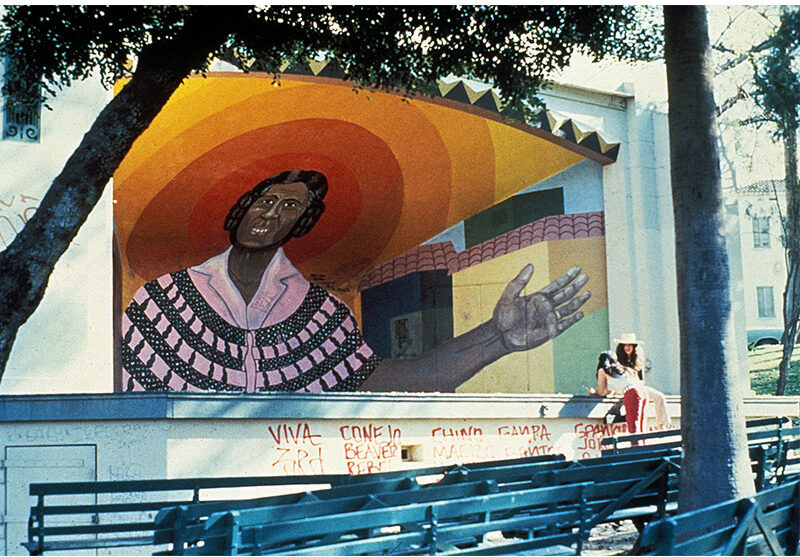
Preeminent Chicana artist of today, Judy Baca began her mural career by gathering a team of twenty gang members from four rival gangs. The unexpected collaboration was a major success. The group chose the name Las Vistas Nuevas (New Views). Their first project was the large mural “Mi Abuelita” (1970) (25’x35’) on the stage of Hollenbeck Park in Boyle Heights. Bringing together one of the most racially diverse Latino and Black communities in Los Angeles was Baca’s primary goal.  Her other goal was “to use public space to create a public voice for, and a public consciousness about people who are, in fact, the majority of the population but who are not represented in any visual way.” 

“Pre-historic California 20,000 B.C. and The La Brea Tar Pits” (1979-1984)

Her next project was “The Great Wall of Los Angeles” (1979-1984) (2754 feet long) (13.5 feet high). The United States Army Corp of Engineers hired Baca to do something with the site of the flood control channel in the San Fernando Valley known as the Tujunga Wash. Baca called the concrete channel “a tattoo on the scar where the river once ran.” Originally called “The History of California,” the images depict the history of Los Angeles, beginning with “Pre-historic California 20,000 B.C. and The La Brea Tar Pits,” the first panel at the southern end of the wall. Baca and experts on history of the area completed the research for the panels, and they conducted interviews with families in the area to gather information about recent times, including their own histories. Skeletons of the saber-toothed tiger, mammoth, and short-faced bear were found in the Tar Pits, as well as specimens of various plant food sources. 

Baca was able to pay her crew with private grants and funding from the Comprehensive Employment and Training Act of 1973 (CETA).  Its purpose was to provide on-the-job training, classroom instruction, and public service employment. Her initial crew consisted of nine other artists, five historians, and 80 young men, aged 14-21, from the criminal justice system. According to Baca parents would allow only their boys to work. A feminist, she actively worked to recruit women for the project.

“The Great Wall of Los Angeles” (1979-1984)

“The Great Wall of Los Angeles” (1979-1984) ends with the “Olympic Champions Breaking Barriers 1964-1984.” It included the image of Wilma Rudolph, who was recognized at the 1960 Olympics in Rome as the fastest woman in the world. The wall was divided into10 segments.  Among the many historical events depicted on the half-mile long wall were the 1848 Gold Rush, Chinese immigrants building the trans-continental railroad, Japanese Americans held in internment camps, the Jazz Age, Zoot Suits Riots, Rock and Roll, and the Freedom Bus Rides. Four hundred muralists worked on the wall over a five-year period.  

“What I learned from the young people who participated is that it changed forever the way that they saw each other. We were in segregated communities…but they were all sorts of ‘rejects’, thought to be young people who will never succeed. But that mixing with each other, which has continued for a lifetime, was a remarkable change.”

In 2023, Baca received a Guggenheim Fellowship, a United States Artists Rockefeller Fellowship, and a Mellon Foundation Grant to extend the Great Wall another 60 feet with panels depicting the Chicano Movement, the Farmworkers Movement, the Watts Rebellion, Freedom Riders, the Civil Rights Movement, and other significant historical events. The Los Angeles County Museum of Art transformed a section of one of its galleries into an active art studio, permitting visitors to watch Baca and her coworkers create the new panels. 

“Seeing Through Others’ Eyes” (2010) and “Tiny Ripples of Hope” (2010)

“Seeing Through Others’ Eyes” (2010) and “Tiny Ripples of Hope” (2010) were sponsored by the Kennedy Commission and the Los Angeles Unified School District. The two murals are located in the Paul Schrade Library at the RFK Community School for K-12 Education. Robert Kennedy was assassinated in June1968 after giving a speech in the Embassy Ballroom of the Ambassador Hotel in Los Angeles. The Hotel was demolished in 2006.  The construction of RFK Community School K-12, to honor Kennedy, was built between 2006 and 2010. Baca’s murals are located in the Shrade Library of the RFK school, where the Embassy Ballroom stood.  The two arched murals (each 12’ 8’’ x 55’) are digital murals. Created by drawing and painting, the murals were digitized.  The project was led by Judy Baca at UCLA. 


“Seeing Through Others Eyes” (2010)

The subject of “Seeing Through Others Eyes” (2010) is the meeting of RFK and Chaves on March 10, 1968, when Chaves had fasted for 25 days to encourage the United Farm Workers to commit to non-violent protests. Kennedy and Chaves attended a mass along with thousands of workers and supporters, and Chaves broke his fast by accepting and eating bread offered to him by RFK.  Kennedy and Chaves are seated at the center of seven lotus petals that represent the social issues of greatest concern to Kennedy: environment, intolerance, poverty, education, health, and war. The lotus flower is important in Buddhism and Hinduism because of its daily cycle, rising from muddy waters and producing a pristine flower.  It is a symbol of purity, enlightenment, spiritual awakening, overcoming adversity, and renewal. The number seven represents completeness, harmony, spiritual perfection, and wisdom in Judaism, Christianity, and Islam. The petal between RFK and Chaves contains a portrait of Oscar Romero, the busboy who held Kennedy’s body when he was shot. In the background is the Million People March.  

“Tiny Ripples of Hope” (2010)

On June 6, 1966, Robert Kennedy spoke at the meeting of the National Union of South African Students at the University of Cape Town on their annual Day of Affirmation, when they reaffirmed their commitment to academic and human freedom. He discussed South African apartheid, African-American poverty, and oppression world-wide. He asserted, “Each time a man stands up for an ideal…he sends forth a tiny ripple of hope, and crossing each other from a million different centers of energy, and daring those ripples to build a current which can sweep down the mightiest walls of oppression and resistance.” Baca chose the title “Tiny Ripples of Hope” for the piece, and she depicted Robert Kennedy, smiling and reaching down to the cheering crowd who lifted their hands up to him, inspired by his message of hope. Behind him the brilliant sunset is in transition to the deep blue, starry night. 

“La Memoria de la Tierra’’ (The Memory of Earth) (2022)

 “La Memoria de la Tierra’’ (2022) (triptych on glass, each panel 10’x26’) was commissioned by a partnership of the UCLA Centennial Commission, the Associated Students of UCLA, and SPARC. The first panel of the triptych (not shown) is a depiction of the history of the campus in Westwood along with the Los Angeles River and native Tongva tribe. The second panel (seen here) is a tribute to the men, women, and important events in the history of the school. At the center of the piece is Baca’s trinity of women. The largest figure represents Toypurina, a Tongva woman who opposed the rule of Spanish missionaries in the Eighteenth Century. To her left is Angela Davis, who was fired from the UCLA faculty for her civil rights activism. At the right is Dolores Huerta, who worked with Ceasar Chaves and the farmworkers. Among the many other persons depicted are John Lewis, Deb Haaland, Martin Luther King, Jr., California Senator Maria Elena Durazo, Authur Ashe, Judy Baca, LA mayor Tom Bradly, Eldridge Cleaver, Kareem Abdul-Jabbar, Jackie Robinson, George Takei, Vietnam protestors, and Black Lives Matter students. The third panel (not shown) is a depiction of a positive future for UCLA.

Baca’s career is one of major achievements and milestones. Among them is “The World Wall: A Vision of the Future Without Fear,” begun in 1987, with panels added by artists from Finland and the Soviet Union in 1990. Artists from Israel, Palestine, Mexico, and Canada added panels in 2004. Mayor Tom Brady asked Baca in 1988 to create and direct the Neighborhood Pride Program for at-risk youth. It has created over 100 murals throughout the city. She was a co-founder in 1993 of UCLA’s Cesar Chavez Center for Interdisciplinary Studies. The Judith F. Baca Arts Academy, a public school located in the Watts neighborhood, was named after her. Judy Baca was awarded the National Medal of Arts in 2021. 

“Murals are not easel paintings. They’re not individual works created for simple self-expression of your opinion in a public space. To do public works means that you’re making something. A real mural is connected to the architecture in which it’s placed, connected to the people for whom it’s painted and connected to who you paint with. And when it is incredibly well done, it’s like a choreographed dance. (Judy Baca, 1/22/2022) 


Beverly Hall Smith was a professor of art history for 40 years. Since retiring to Chestertown with her husband Kurt in 2014, she has taught art history classes at WC-ALL and the Institute of Adult Learning, Centreville. An artist, she sometimes exhibits work at River Arts. She also paints sets for the Garfield Theater in Chestertown.

The Spy Newspapers may periodically employ the assistance of artificial intelligence (AI) to enhance the clarity and accuracy of our content.

Filed Under: Looking at the Masters

Looking at the Masters: Judy Baca

October 2, 2025 by Beverly Hall Smith

Judith Francisca Baca was born in 1946 in Watts, a southern Los Angeles district.  Her parents were Mexican-Americans, and Watts was largely a Latino and Black community. Judy was immersed in the culture, speaking only Spanish. Her mother remarried, and they moved to Pacoima, a predominately white district of Los Angeles. She was not allowed to speak Spanish in elementary school, isolating her until she became fluent in English.  During that time, she was encouraged to sit quietly and draw. After graduating from a Catholic high school in 1964, she went on to earn a bachelor’s degree in fine art in 1969 and master’s degree in 1979 from the California State University, Northridge. Her desire to make art for the people she loved gave her direction: “I thought to myself, if I get my work into galleries, who will go there? People in my family hadn’t ever been to a gallery in their entire lives. My neighbors never went to galleries…And it didn’t make sense to me at the time to put art behind some guarded wall.” 

Baca continued her education at La Tallera, in Cuernavaca, Mexico. The school was founded by Mexican artists Diego Rivera and David Siqueiros who had elevated mural painting to an international level. According to Siqueiros, “The space was born of an idea that Diego Rivera and I had since 1920, that is, the creation of a real workshop for Mural Painting; here the different techniques, materials, paintings, perspectives and geometric aspects will be rehearsed.”


“Mi Abuelita” (My Grandmother) (1970)

In the summer of 1970, Baca brought together twenty young people from four rival gangs in Boyle Heights to paint murals. She had gotten to know them over time, and she wanted to try to create “a public consciousness about people who are, in fact, the majority of the population but who are not represented in any visual way.”  The group chose the name Las Vistas Nuevas (New Views). Their first project, “Mi Abuelita” (My Grandmother) (1970) (25’x35’) (acrylic on concrete) was a mural painted on three walls of the outdoor stage in Hollenbeck Park. The mural was based on a photograph of Baca’s grandmother. Her arm outstretched, she offers a welcoming smile and hug to all. Her hairstyle, clothing, the simple city scape, and the sunshine complete the story. Baca chose the simplified drawing and coloring of the Mexican mural tradition she had seen, revered, and studied.  Baca stated, “This work recognized the primary position of the matriarch in Mexican families. It also marked the first step in the development of a unique collective process that employs art to mediate between rival gang members competing for public space and public identity.”  

Baca’s grandmother was a major figure in the community. “But my grandmother was indigenous and she looked Apache,” said Baca.  She was a curanderismo, a Hispanic, indigenous, Catholic, and folk healer, who used herbs, rituals, prayers, spiritual cleansings, and massages to achieve healing. People of the community came to her for healing of bodies and souls. The mural was a great success and Baca stated, “Everybody related to it. People brought candles to that site. For 12 years people put flowers at the base of the grandmother image.” 

During the painting of the mural, the local police feared that rival gangs might react with violence. Baca posted lookouts from the team who would whistle if they saw danger coming from gangs or the police. Complaints came in. Baca wrote, “After seeing the progress and team members working so well with each other…the city was amazed at the work I was doing, making murals with kids who scared directors out of neighborhood centers.”

Aa a result of the success of the mural project, Baca was named director of a new citywide mural program. She could choose the sites, design, and supervise their creation. Las Vistas Nuevas members were hired to work with Baca. The group would paint over 500 murals. 

In 1976 Baca, Christina Schlesinger, and Donna Deitch created the Social and Public Art Resource Center (SPARC), a non-profit organization in Venice, California. Its mission is “to produce, preserve, and promote activist and socially relevant artwork; to devise and innovate excellent art pieces through participatory processes; and ultimately, to foster artistic collaborations that empower communities who face marginalization or discrimination.” Baca commented, “I really liked the idea that the work could not be owned by anyone. So, it wasn’t going to be interesting to the rich or to the wealthy, and it didn’t have to meet the caveats of art that museums would be interested in.’’ 

“Hitting the Wall” (1984)

Baca’s art included themes of women’s rights. “Hitting the Wall” (1984) (25’x100’) was commissioned by the Los Angeles Olympic Committee. It used the opportunity of the 1984 Summer Olympics to highlight the City by commissioning ten murals by Los Angeles artists, one of them, Judy Baca. The ‘84 Olympics was the first to include a women’s marathon, earlier considered to be too dangerous for women even to attempt. Baca interviewed several marathon runners, and their stories about “hitting the wall” at 20 and 24 miles became her subject. They feared their muscles would run out of stored energy and begin to shut down. Completing the race relied on their mental strength. The large heart at the right side of the mural is a symbol of the heavy beating of the runner’s heart.  

The 25-foot-tall runner breaks through the green finish line tape and the turquoise wall, symbolically breaking down barriers to success. The Aztecs believed the Sun was made of turquoise and was associated with Xiuhtecuhtli, the primordial god of creation, the Turquoise Lord, lord of celestial cycles, renewal, fire, rain, and fertility. Turquoise was used in the making of weapons, beads, and ritual objects. The city of Los Angeles can be seen on the right, behind the Finish Line.  At the left the Tower of Babel falls, a reference to the universal understanding that females should not be limited.

Robert Fitzpatrick, director of the Olympic Arts Festival, chose the location of the ten murals on the ten downtown freeway exits into Los Angeles because the path to the ancient Greek Olympics was along a major entryway to Athens lined with statues. Artists received $15,000 each for their projects. They paid thousands of dollars for insurance and barriers to protect painters and drivers over the nine months required to complete the project. Baca’s “Hitting the Wall” was located at the 4th street off-ramp of route 110. The exit led to the Music Center. 

Tagging the murals was a big problem. Baca and SPARC restored this mural several times. Tagging and over painting outside art work is an on-going issue. Talented graffiti artists deplored the situation, stating “We are all artists. These taggers show a lack of respect for other people’s work and a lack of understanding that murals are a part of the tradition that paved the way for us.” On May 2, 2024, the Los Angeles Country Museum purchased a group of Baca drawings for “Hitting the Wall” for the permanent collection. These were the first Baca works to enter the Museum’s collection. That purchase is directly connected to the 2028 Los Angeles Olympics sponsors recognition of the mural as a significant art form in Los Angelos. 

“Arch of Dignity, Equality, and Justice” (2008)

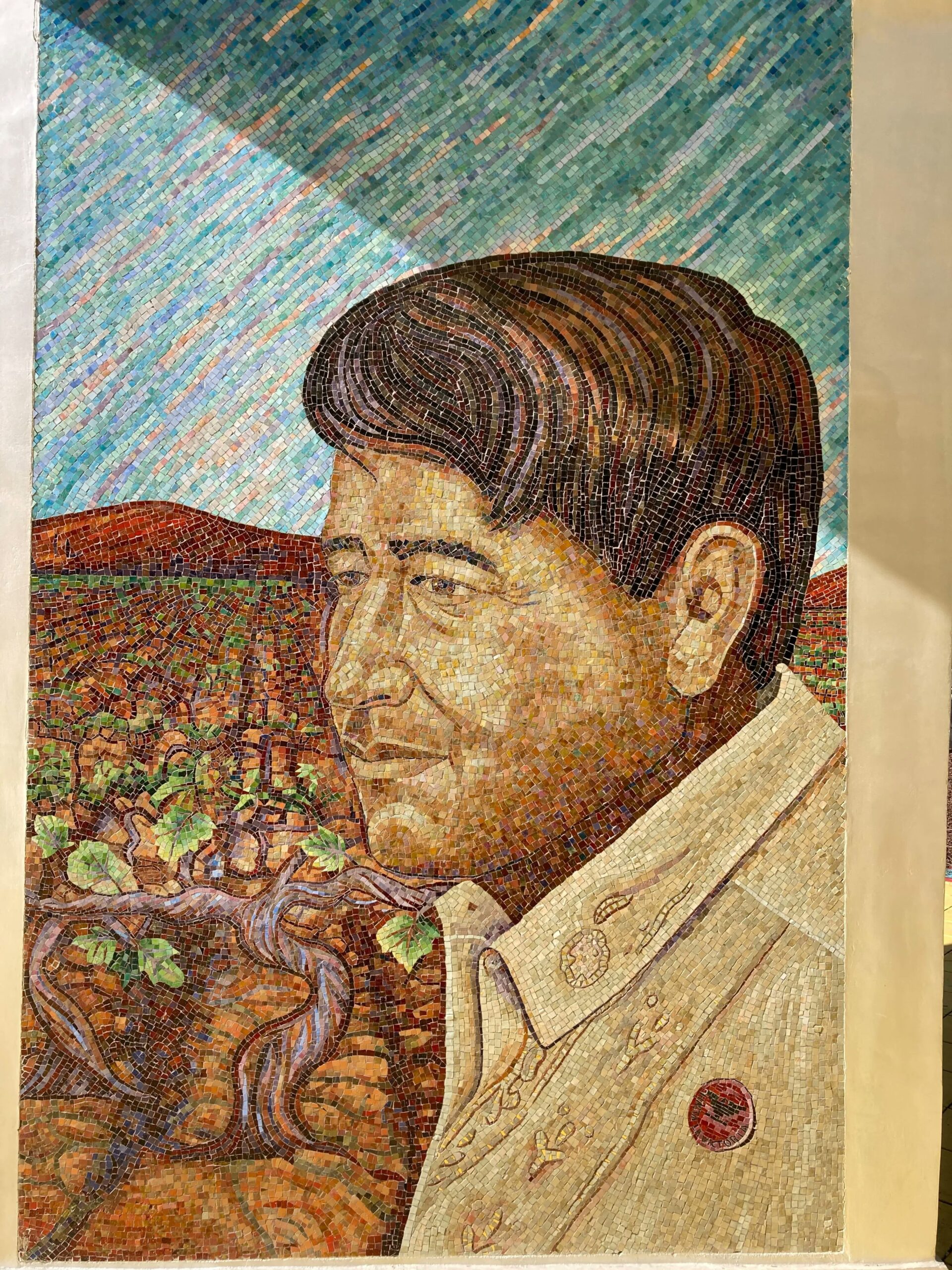
“Arch of Dignity, Equality, and Justice” (2008) was commissioned by San Jose State University as a memorial to Ceasar Chaves, American labor leader and civil rights activist. This was not to be a traditional monument to a fallen soldier, but as Baca stated, “It is not Cesar’s personality that is to be remembered, but his ideals and beliefs.”  The arch opening was designed to resemble the Mayan arch with sides slanted toward the center. It was the doorway opening to temples, tombs, and ceremonial buildings. Placed at the top of the arch is a turquoise glass mosaic eagle, the symbol of the United Farm Workers. A ton of glass was specially ordered from Cuernavaca, Mexico, for the mural. Mosaic portraits of Mahatma Gandhi and Dolores Huerta can be seen in this view. Baca included Gandhi to represent non-violence in the fight for human rights. Dolores Huerta was co-founder of the United Farm Workers and an activist and advocate for farm workers, particularly women. She worked to develop legislation for equal human rights. The figures in the niches (each 4’ by 9’) on the other side of the arch are depictions of male and female farmworkers who picked crops in the Salinas Valley. 

“Ceasar Chaves”

Inside the arch one mosaic is a depiction of Ceasar Chaves contemplating the furrowed field and green leaves of a flourishing crop, also where the boycotts took place. On his shirt is the symbol of the United Farm Workers, a red pin with a black eagle. Above his head, on the slanted panel (not shown), is the Virgin of Guadalupe, the patron saint of Mexico. Mary appeared in 1531 to an Aztec Christian named Juan Diego near what is now Mexico City. The Virgin blesses Chaves. Beneath her image is a skull, representing the death of farmworkers caused by pesticides. Across from Chaves is Robert Kennedy (not shown). On March 10, 1968, Chaves broke a 25-day protest fast and accepted bread from Senator Kennedy. In his speech Kennedy referred to the day as an “historic occasion” and said they were “locked in the struggle for justice for the farmworkers, and the struggle for justice for the Spanish-speaking Americans.” The arch stands next to the Student Union Building to ensure people walk through it. Chaves stated, “A symbol is an important thing, that is why we chose an Aztec eagle. It gives pride…When people see it, they know it means dignity.”

#5 “Gente de la Maiz” (People of the Corn) (2012)

“Gente de la Maiz” (People of the Corn) (2012) (18’x33’) was commissioned by Maria Elena Durazo of the AFL-CIO in collaboration with the UCLA Labor Center and the Miquel Contreras Learning Center, and SPARC. The mural celebrates the work of labor leader Miguel Contreras (1952-2005), who brought Latino immigrant workers into the AFL-CIO, making major improvements in their lives. Baca designed the mural with the help of high school students from the Contreras Center. Baca and the students conducted interviews in their communities in order to tell the story of the struggle of documented and undocumented immigrants to overcome obstacles and to achieve success. The project was completed in twenty weeks, and the mural was placed in the cafeteria of the Miguel Contreras Learning Complex. 

The major figure is Karina Perez Alvarado, who met Baca when she was a high school senior. She showed Baca some of her sketches, and Baca encouraged her to enroll in one of Baca’s classes at UCLA. Baca taught art classes at UC Irvine from 1980 until 1996, and then at UCLA from 2002 until 2018. She was a professor of Chicano Studies in the World Arts and Cultures Department. She also taught at the Miguel Contreras Center. In the piece, Alvarado wears a cap and gown, and she raises her head and hands in thanks. She took Baca’s advice. She graduated from UCLA, and she is a Contreras alumna, who also works at the Contreras Center. She spoke about the role of education in her life: “It’s an empowerment that never dies and something I carry with me wherever I go. If children can learn that ‘my experience matters and I can share my experience through art and something visual’ those kids are going to be forever influenced and empowered. I think that’s a beautiful thing Judy is doing.” 

Alvarado stands at the center of the large ear of corn. To her left, representing agriculture, is a field where corn is being harvested. To her right is an expansive view of Los Angeles where she can now take her place, but not without continued struggle. In the foreground, women march peacefully in support of the passage of the Dream Act, legislation to create a pathway to citizenship for undocumented immigrants who came to American as children.

Two male students also stand with Alvarado on the corn cob. One student sprinkles a handful of corn seeds. The other pours water from his hands. Kernels of corn and a halo are behind Alvarado’s head.  Large kernels of corn fall from her hands, and her graduation gown resembles kernels of corn in the cob. The past, the present, and hope for future are connected.

October is designated Spanish Heritage Month. As a Chicana, Baca’s choice of designation, she continues to work for social justice by creating collaborations that bring disparate groups of people together. 


Beverly Hall Smith was a professor of art history for 40 years. Since retiring to Chestertown with her husband Kurt in 2014, she has taught art history classes at WC-ALL and the Institute of Adult Learning, Centreville. An artist, she sometimes exhibits work at River Arts. She also paints sets for the Garfield Theater in Chesterto

The Spy Newspapers may periodically employ the assistance of artificial intelligence (AI) to enhance the clarity and accuracy of our content.

Filed Under: Looking at the Masters

Looking at the Masters: Camille Pissarro

September 25, 2025 by Beverly Hall Smith

Fall began on Monday, the name of the season appearing in a 17th century phrase referring “to the fall of the leaves.” The British would say the season is Autumn, coming from the Latin autumnus, dating to the 13th century. The work of Jacob Andrew Camille Pissarro (1830-1903) is an excellent choice for depictions of the seasons. A Danish-French Jew, one of the original Impressionists, Pissarro paid close attention to the visible aspects of nature during all the seasons of the year. Art critic Emile Zola recognized and wrote about the artist’s expertise after viewing a Pissarro Pontoise landscape in the !868 Salon: “This is the modern countryside. One feels that man has passed by, turning and cutting the earth…And this little valley, this hill has a heroic simplicity and forthrightness. Nothing would be more banal were it not so grand. From ordinary reality the painter’s temperament has drawn a rare poem of life and strength.”

“Houses at Bougival, Autumn” (1870)

Pissarro lived in Louveciennes near Bougival from the Spring of 1869 until September 1870, and he returned with his new wife sometime during the period of 1871 to 1872. “Houses at Bougival, Autumn” (1870) (14’’x18’’) is set early in the season. Some trees have just begun to lose their leaves, while others hold on to their green leaves. A woman and child have a discussion by the side of the dirt road. He has a bookbag over his shoulder, and she carries a basket. The boy’s blue jacket and the woman’s blue shawl provide protection from the chill in the air. Pissarro has chosen to use a range of greens and reds, complementary colors, and a light blue sky to create a bright but not sunny autumn day. Warm yellows are missing from the scene.  The well-wrapped woman with the basket appears to be gathering vegetables in the small field of furrowed rows. Pissarro painted a charming and inviting rustic village with trees and rows of country houses. 

”Hoarfrost, ancienne route d´Ennery, Pontoise”’ (1873)

In “Hoarfrost, Old d’Ennery Road, Pontoise” (1873) (26”x37’’) gray/white crystals of frozen water vapor rise from on the fields at Pontoise. A man, bundled up against the chill and walking with a cane, carries a load of kindling through the field covered with hoarfrost. To generate greater visual interest, Pissarro painted crisscrossed plowing patterns on sections of the field, like a quilt laid on the ground. Strategically placed trees and the light blue, cloud-filled sky draw the viewer into the scene. Pissarro’s painting is remarkable.

“Harvest, Pontoise” (1881)

Pissarro was one of the founding members of the Impressionist group, and he showed his work in all eight of the group’s exhibitions. He continued to depict rural life, a subject he never tired of, and he worked in oil, pencil, gouache, charcoal, and he made prints. “Harvest, Pontoise” (1881) (18’’x22’’) (oil) signals a new direction as Pissarro gave human figures greater importance. In this piece, three workers are harvesting potatoes, a subject he repeated. They stay close together so they do not miss any ripe ones. They have been at it for a while, judging by the bulging brown sacks.  Pissarro perfected the Impressionist style with loose brush strokes to create the movement of air and people as they work outdoors. He chose complementary colors to create the atmosphere of a sunny day. These paintings demonstrate his renewed vigor.

“Picking Peas” (1887)


“Picking Peas” (1887) (gouache) (21”x25’’) is evidence of Pissarro’s interest in and study of pointillism, a style introduced by George Seurat in the 1880s. A Post-Impressionist, Seurat placed small dots of color next to each other rather than mixing them on a palette. From a distance the viewer’s eye would blend the colors. Pissarro chose to use more obvious spots of paint next to each other. The group of five women picking peas are prominent and create a sense of community. Pissarro painted their clothing with more traditional brush work, particularly in the shadows cast on the blue skirts.

“Picking Peas” was commissioned by Theo VanGogh, Vincent’s brother, who worked for the Paris art dealer Goupil & Cie. The painting belonged to Simon Bauer, a French Jew and a well-known art collector. The entire Bauer art collection was confiscated by the General Office for Jewish Affairs of the Vichy government under the Nazis (1943). Bauer’s collection and that of many Jewish families disappeared. Locating and recovering confiscated art remains an issue in 2025. Pissarro paintings are among them. When Simon Bauer’s 90-year-old grandson Jean-Jaques Bauer learned that ”Picking Peas” was listed in a Pissarro retrospective exhibition in France in 2017. The legal battle for the painting began. After several years of negotiation, the painting was restored the Bauer family in 2020. The Nazis stole many Pissarro paintings from Jewish families.

Pissarro stopped painting in plein air as a result of an eye infection in 1893.  But he never stopped painting. After hundreds of paintings of rustic life, he had to leave his beloved workers in the fields to paint scenes from inside hotels looking down from second story windows. He continued to live in Pontoise until his death.  Called “the father of Impressionism,” Pissarro was loved and respected by his fellow artists and by an appreciative public.

“Blessed are they who see beautiful things in humble places where other people see nothing.” (Camille Pissarro)  

Note:  See the article (SPY, July 25, 2025) on Pissarro’s paintings from upstairs in Paris and other cities during various seasons of the year. 


Beverly Hall Smith was a professor of art history for 40 years. Since retiring to Chestertown with her husband Kurt in 2014, she has taught art history classes at WC-ALL and the Institute of Adult Learning, Centreville. An artist, she sometimes exhibits work at River Arts. She also paints sets for the Garfield Theater in Chestertown.

The Spy Newspapers may periodically employ the assistance of artificial intelligence (AI) to enhance the clarity and accuracy of our content.

Filed Under: Looking at the Masters

Looking at the Masters: Mary Morris Vaux Walcott

September 18, 2025 by Beverly Hall Smith

Mary Vaux Walcott (1860-1940), considered to be one of America’s most important naturalists, recorded in watercolor paintings over 1000 North American plants.  She became known as the Audubon of Botany. Her parents were Sarah and George Vaux, well-educated and wealthy Philadelphia Quakers. Mary was given a set of watercolors when she was eight years old, and she began to paint flowers. Her contribution would extend beyond painting pretty flowers.

”Watercolor Study (1873)

Mary’s talent at a young age is apparent in this early work “Watercolor study” (1873).  She signed the sketches “M.M. Vaux 4th month 1873.” The pansies are well drafted, the colors softly modeled, and the texture appears velvety. She paints the shadow cast by the blooms and stems. 

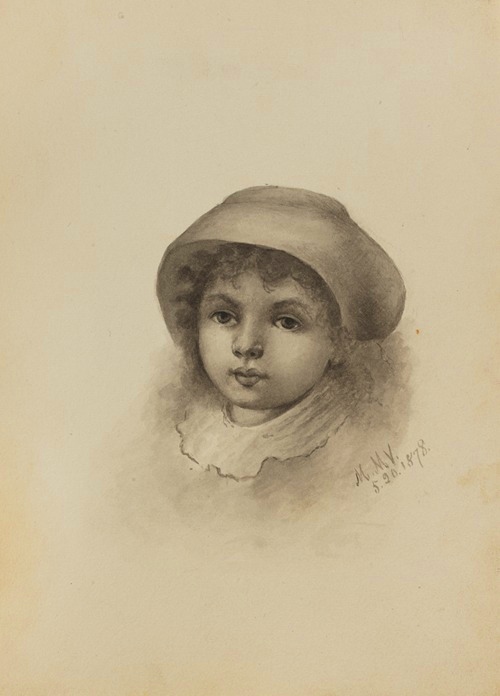
‘Child’s Head” (5-20-1878)

Although Mary did not pursue portraiture, this early work is an indication that her talent went far beyond the ability to render flowers. In her time, women were considered incapable of painting anything but flowers.

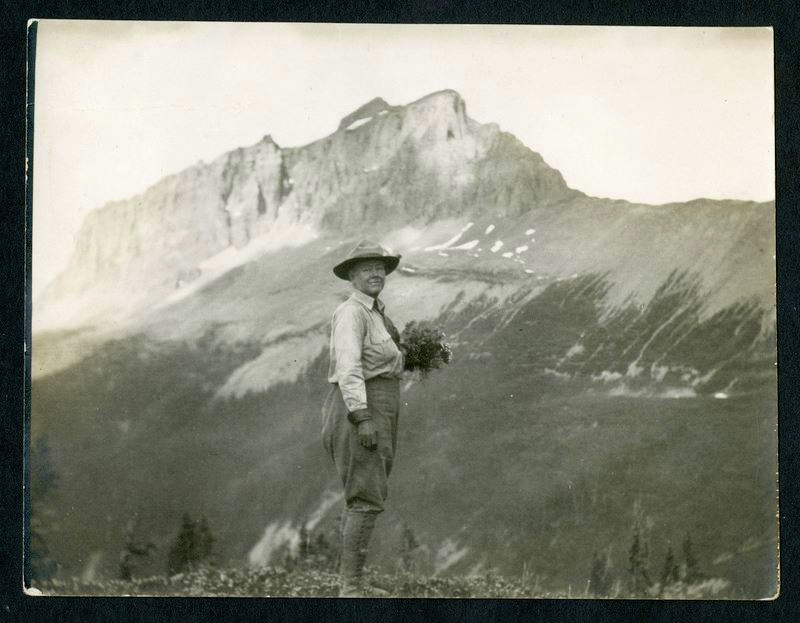
‘Mary VauxxWalcott in Canadian Rockies with Wild Flowers” (1920’s)

Mary Vaux graduated in 1879 from the Friends Select School in Philadelphia. No specific record states that she ever studied painting. She worked on the family farm, and the family took trips in the summer to the Rocky Mountains in Canada. After her mother died in 1880, she became solely responsible for the care of her father and two brothers. 

Her father and an uncle were interested in mineralogy, and she and her younger brothers George and William were educated in science. Mary was an active mountain climber, photographer, and painter. She and her brothers were founding members of the Alpine Club of Canada in 1906, and she became an advocate for women wearing trousers because they were safer when climbing. 

The adventurous Vaux family made their first transcontinental trip in 1887 by rail, carriage, stagecoach, ferry, horseback, and foot through the American and Canadian Rockies. They were among the first passengers to ride on the newly constructed Canadian Pacific Railroad. The 10,000-mile journey included a train crash and derailment. In the Selkirk Mountains in British Columbia, they photographed the nearby Illecillewaet Glacier. From 1887 until 1912, Mary Vaux took over 2500 photographs of the glacier. The Vaux family wrote about climate change causing the shrinking of the glaciers. In a letter written in 1912 to her future husband Charles Walcott, Mary Vaux wrote, “The glaciers must be measured, and I shall hope to use the camera seriously, and get all I can.” The Vaux collection of photographs of the glaciers is in the Whyte Museum in Banff, Alberta, Canada. 

Mary Vaux wrote in her article “Camping in the Canadian Rockies” for Canadian Alpine Journal, “A camera is a very delightful adjunct, for it is pleasant to have some tangible results to show, on your return home. A Kodak, if no larger instrument can be managed, yields most satisfactory results, although the better records from a larger-sized camera are an increased delight, when one has the patience and skill to obtain them. For changing plates in camp, an improvised tepee can be made of the blankets, and, if this is done after sundown, is quite satisfactory.”

Her search for wild flowers involved an enormous commitment of time and energy, and it was dangerous work. She was relentless, scrambling around rocks, over ledges and cliffs. Perched safely or precariously, she made quick but careful studies in the field. Full watercolor paintings, finished in camp, were the same size as the plant. 

Her younger brother died in 1908. By 1911, her other brother’s responsibilities made it impossible for him to travel with her, and her father had become too old. She decided to travel alone to continue photographing the glacier and painting the flora. She traveled with a female friend from time to time. 

In 1914, over her father’s strong objection, she married Dr. Charles Doolittle Walcott, who was Secretary of the Smithsonian Institution. The two worked together for three or four months every year in the Canadian Rockies and elsewhere. He pursued his well-respected studies in paleontology, and she painted hundreds of watercolors of native plants.

”Arrowleaf Balsamroot” (1923)

On one trip, a botanist asked Mary Vaux Walcott to do a painting of a rare blooming arnica flower. It was so successful, he encouraged her to consider botanical illustration. She took up the idea and initiated another of her important contributions.  “Arrowleaf Balsamroot’’ (1923) is a depiction of a plant that grows across the western United States in the Black Hills of South Dakota, Arizona, the Mojave Desert of California, and in the British Columbia and Alberta provinces of Canada. It blooms in May and June in both mountain forests and desert grasslands.  

The Nez Perce, Cheyenne, and Salish tribes, among others, used the plant for both food and medicine. Lewis and Clark collected specimens of the plant from the White Salmon River in 1806 and brought them back to the East with other discoveries. Known also as the Oregon Sunflower or Okanagan Sunflower, the arrowleaf balsamroot is the official flower of Kelowna, British Columbia, Canada.

”Rocky Mountain Cassiope” (1924)

“Rocky Mountain Cassiope” (1924) is a depiction of a plant that can be found in the west from Alaska to California in subalpine areas growing close to the ground and in rocky crevices. The plant makes a significant contribution to snowmelt and stream flow. Walcott depicts the low growing plant with red stems that hold small white star-shaped flowers. The name Rocky Mountain refers to the plant’s location and Cassiope, from Greek mythology, refers to its star-shaped flowers. Cassiopia, an Ethiopian Queen, boasted that she and her daughters were more beautiful than the 50 Nereids (sea nymphs) who are symbols of everything beautiful about the sea.  An angry Poseidon, God of the Sea, killed them and turned mother and daughters into a constellation.

The Smithsonian Institution published Mary Vaux Walcott’s North American Wild Flowers in 1925. The five-volumes included 400 of her watercolor illustrations along with scientific information, medicinal uses, and poetic references. Proceeds from sales were donated to the Smithsonian endowment. William Edwin Rudge (1876-1931) had developed a new printing technique known as the Smithsonian Process.  Mary Vaux Walcott wrote to a friend in 1924, “The result is a reproduction that can hardly be told from the original sketch.” Each volume had 80 prints and like her watercolors, the flowers were printed at their “natural size.” 

”Engelmann Spruce” (1925)

The Engelmann Spruce was first identified in the mid-19th Century by George Engelmann, a German-born doctor and botanist who lived in St Louis, Missouri. He was an authority on conifers, or cone bearing trees.  In tribute to his discovery of this previously unknown conifer, the spruce was given his name. The watercolor “Engelmann Spruce” accurately depicts the cones and branches. 

Found in high mountains the tree can live for as long as 300 years.  The wood is light in weight, has a straight grain, and is strong. The Engelmann Spruce can be used for construction, and because it is odorless and has little resin, it is used in making barrels and food containers. However, its real value is in the quality of the sound when the wood has been used to make soundboards for guitars, harps, violins, and pianos. 

”California Poppy” (1935)


In 1935 the United States Post Office Department issued the California Pacific Exposition stamp, featuring Mary Vaux Walcott’s “California Poppy” watercolor, signed and dated 4-10-35. The state flower of California, the poppy is an annual that self-seeds, but it is not an invasive plant. The flowers can be bright orange or yellow. They bloom from February to September. 

Mary Vaux Walcott excelled at many endeavors during her life time. She is recognized as the first woman to climb to the height of 10,000 feet on Mount Stephens in British Columbia (1900). A mountain in British Columbia was given the name Mount Mary Vaux in 1908.  She was a significant influence in the establishment of the National Park Service in1916. The Walcotts established the Charles D. and Mary V. Walcott Research Fund for geological and paleontological research. It exists today. When her husband died in 1927, she created the Charles Doolittle Walcott Medal in his honor. It is awarded every five years by the National Academy of Science. President Calvin Coolidge appointed her to the Board of Indian Commissioners in1927, and she served until 1932. She visited over 100 reservations. She became the president of the Society of Women Geographers in 1933.

She continued to lecture on botany and photography. The lectures attracted as many as 3.000 attendees.  Walcott continued to collect and press hundreds of plant specimens for the Smithsonian and donated hundreds of her flower watercolors which are now housed in the Smithsonian American Art Museum. She was an extraordinary hostess during her many years in Washington, DC. Friend of many important people, she was especially close to President Herbert Hoover and his wife Lou, who also were Quakers. Walcott led the funding and building of the first Quater Meeting House in the national capital. She stopped climbing mountains in 1939. She died in 1940. The Smithsonian Institution reprinted her work and the “x Rhyncattleanthe Mary Vaux Walcott” hybrid orchid was named in her honor.

“I don’t know why it is. Women have time for bridge parties and dances, yet they miss so much by not turning their attention to scientific studies and using their eyes. There is a thrill one receives from breaking a rock and finding a fresh fossil that nothing else can give. There is the romance of not knowing what one will find.” (Mary Vaux Walcott)


Beverly Hall Smith was a professor of art history for 40 years. Since retiring to Chestertown with her husband Kurt in 2014, she has taught art history classes at WC-ALL and the Institute of Adult Learning, Centreville. An artist, she sometimes exhibits work at River Arts. She also paints sets for the Garfield Theater in Chestertown.

The Spy Newspapers may periodically employ the assistance of artificial intelligence (AI) to enhance the clarity and accuracy of our content.

Filed Under: Looking at the Masters

  • 1
  • 2
  • 3
  • …
  • 28
  • Next Page »

Copyright © 2026

Affiliated News

  • The Cambridge Spy
  • The Talbot Spy

Sections

  • Arts
  • Culture
  • Ecosystem
  • Education
  • Health
  • Local Life and Culture
  • Spy Senior Nation

Spy Community Media

  • About
  • Subscribe
  • Contact Us
  • Advertising & Underwriting

Copyright © 2026 · Spy Community Media Child Theme on Genesis Framework · WordPress · Log in