
MENU

Sections

  • Home
  • About
    • The Chestertown Spy
    • Contact Us
    • Advertising & Underwriting
      • Advertising Terms & Conditions
    • Editors & Writers
    • Dedication & Acknowledgements
    • Code of Ethics
    • Chestertown Spy Terms of Service
    • Technical FAQ
    • Privacy
  • The Arts and Design
  • Local Life and Culture
  • Public Affairs
    • Ecosystem
    • Education
    • Health
  • Community Opinion
  • Donate to the Chestertown Spy
  • Free Subscription
  • Talbot Spy
  • Cambridge Spy

More

  • Support the Spy
  • About Spy Community Media
  • Advertising with the Spy
  • Subscribe
November 11, 2026

ARCHIVE Chestertown Spy

Nonpartisan and Education-based News for Chestertown

  • << RETURN TO CHESTERTOWN SPY
  • << RETURN TO CHESTERTOWN SPY
1A Arts Lead Archives

Spy Review: A Rousing Chesapeake Season Opener by Steve Parks

October 2, 2025 by Steve Parks

Renaissance String Quartet

The season debut of  Chesapeake Music’s popular Interlude concert series marked the return of the New York City-based Renaissance String Quartet – friends for a decade or more who honed their skills at the Juilliard School and the prestigious Perlman Music Program. The foursome – violinists Randall Goosby and Jeremiah Blacklow, violist Jameel Martin, and cellist Daniel Hass – were joined in Sunday evening’s chamber concert by pianist Zhu Wang and Chesapeake Music’s co-artistic director, violist Catherine Cho.

Goosby made his Ebenezer Theater debut two years ago, featured with piano wunderkind Wang in a memorable “Stars of the Next Generation” concert. Goosby returned later in 2023, performing with members of the internationally acclaimed Orion Quartet and other seasoned musicians as part of the annual Chesapeake Chamber Music Festival. 

The Renaissance foursome played the opening night program with major assists from their former teacher and mentor, Cho, who fulfilled Mozart’s two-viola requirement for his famous String Quintet No. 4 in G Minor. And Wang brought his keyboard virtuosity to bear in Brahms’ masterpiece, the Piano Quintet in F Minor, Op. 34. 

The concert opened with what Goosby promised was a piece probably no one in the audience had heard before, though it was composed about 90 years ago. Price’s String Quartet No. 1 was almost lost forever, rescued just before the demolition of her former summer home near Chicago in 2009 – nearly 70 years after her death. It was discovered alongside dozens of other scores that had never been published or performed publicly – many of which had been recorded and played in concert. The 17-minute, two-movement string quartet begins with gentle flourishes that build subtly toward a boldly declarative finish. The highly romantic second movement, with a charming theme introduced by violinist Goosby, accented by pizzicato changes of tempo, leads to a dreamy sequence that brings to mind a tearfully tender lullaby.

The Mozart quintet features his signature repetitive mini-themes throughout which go from typical G minor pathos in the allegro opening to dire suggestions of danger and melancholy in the second – played with animated conviction by cellist Hass and amplified by the dual violists. The third movement adagio features mournful exchanges expressively delivered – as if in conversation by violinists Blacklow and Goosby with violists Cho and Martin. The final movement presents a conundrum ranging from dirge and lamentation at the start before switching abruptly to G major ebullience in an it’ll-all-work-out finale executed with optimistic flair by this engaging quintet. 

Following intermission, the best of Brahms was performed with the gusto and commitment it deserves by the Renaissance String Quartet plus one – pianist Zhu Wang, a multi-award winner on an international scale.

Written in his early prime years, ages 29 to 31, and first performed four years after he started, the piano quintet is often referred to as the “crown jewel” of Brahms’ chamber music career. But it hardly came easy. Brahms composed it first as a quintet with two cellos and next as a two-pianos sonata, before settling on what became the piano quintet standard – string quartet plus piano.

The allegro opening in sonata form makes near equal use of all the instruments in a unison theme. And throughout, the piano and strings play a similarly equal role. The second movement, andante, presents a storytelling theme that again, as in the Mozart quintet, brings the piano in expressive conversation with the strings. Wang carries the burden with calm and aplomb as he is one player engaged with four others in a piece that Brahms once wrote for a pair of pianists.

By the third movement we begin to expect something’s afoot thematically as a hint of intrigue and danger emerges in an apprehensive piano segment delivered by Wang accompanied by a plucking heartbeat strummed by cellist Hass.

In the finale, apprehension turns to tumult as the tempo builds into presto intensity, thunderously deployed by each of the fever-pitch five, culminating in a fiercely intense climax to this stirring chamber masterpiece. 

A notable footnote: Goosby, who’s become something of a Chesapeake Music audience favorite, also performed with fellow quartet musicians and chatted with students Thursday as part of the BAAM (Building African American Minds) Afterschool Program, and again Friday at Mace’s Lane Middle School in Cambridge.

CHESAPEAKE MUSIC INTERLUDE CONCERT

Sunday evening, Sept. 27, Ebenezer Theater
Prager Family Center for the Arts, Easton.
chesapeakemusic.org

Steve Parks is a retired New York arts critic now living in Easton.


The Spy Newspapers may periodically employ the assistance of artificial intelligence (AI) to enhance the clarity and accuracy of our content.

Filed Under: 1A Arts Lead, Archives

Spy Review: A Bold MSO Season Opener by Steve Parks

September 26, 2025 by Steve Parks

 The Mid-Atlantic Symphony Orchestra bills its 28th season, 2025-26,  as one of “Bold Voices, Eternal Resonance.” It’s hard to beat Beethoven for eternal resonance. And as for bold voices, Bartok certainly comes to mind. But for a surprise entry opening night Thursday at the Easton Church of God, music director Michael Repper turned to a 19th-century composer whose music is largely new to 21st-century listeners.

 Emilie Mayer (1812-1883) was one of the first European women to make her mark as a composer of orchestral music. But her Symphony No. 1, performed by the MSO, and her entire classical canon – including seven other symphonies along with piano sonatas and chamber works – was all but forgotten after her death. Never mind that she was hailed as the “Female Beethoven” and in popular demand for her Romantic repertoire, especially in her native Germany.

The evening opened with Bela Bartok’s Romanian Folk Dances he created as a way to overcome post-World War I depression. Inspired by tunes he heard during trips to Transylvania, the piece runs seven minutes or so, played orchestrally. In such a short span – one of the bits is 30 seconds start to finish – the tunes fly by almost indiscernibly one from another. Better to consider them a single folk instrumental ranging in tempo and temperament from fast to slow, gleeful to wistful. While strings set the tempo, reeds rule the temperament – especially flutes (led by Mindy Heinsohn) – which moved Bartok to get over his funk.

The Bartok appetizer whets our palate for a main course. And Emilie Mayer does not disappoint. For a first symphony, each of the four movements are mature, diverse in style and way ahead of her time, having debuted in Berlin in 1847. The opening adagio/allegro energico morphs from contemplative to bombastic. Energetic for sure.  The slower second movement gives us and the players time to catch our breath before it grows in emotional intensity. A satisfyingly lively and rhythmic scherzo leads to a finale testing every part of the orchestra to peak at the climatic close of what for me and most of the audience was a triumphant debut, sadly, for a long dead and neglected composer. My suggestion going forward is to bring Mayer back to musical life with one of her later pieces: Repper mentioned her “Faust Overture” – if not for this season, perhaps next.

After intermission, the “male” Beethoven, one of Mayer’s early classical music heroes, proved his “eternal resonance” in a spirited performance of his Symphony No. 7, which the master himself called one of his greatest works. 

The odd-numbered genius can hardly be surpassed in Symphonies 5, 7 and 9, compared to which even the estimable No. 4 is a dud. And for my money (which I am not betting on) his Symphonies 7 and 9 outrank even the fabled 5th. There is not a moment in the 7th that permits your attention to wander for one note. It must be a thrill for someone who can play for a living to perform with a full and entirely capable orchestra of fellow musicians by a conductor who knows how to lead.

So the particulars: The distinctively familiar opening, with a single note repeated thrice, establishes the movement’s prevailing theme, picking up the pace feverishly to a dramatic finish that would bring a less informed audience to its feet in bravo appreciation. The second movement allegretto settles into an almost lullaby cadence before bursting into a declarative resolution offset by the playful exuberance of the presto scherzo to follow.  

  The allegro con brio finale begins as if it’s at the fantastic finish line, though it’s way too soon to go home. Bow-to-string lightning bolts and thunderous drumbeats are about to strike, led by concertmaster Kimberly McCollum and associate Paula Sweterlitsch, along with violist Yuri Tomenko, cellist Katie McCarthy, bassist Chris Chlumsky , and timpanist Barry Dove. 

Coming up in early November is “Echoes of Greatness” with guest conductor George Jackson leading the MSO in a program of Mozart and Mendelssohn symphonies and a Beethoven overture.

MID-ATLANTIC SYMPHONY SEASON OPENER

Easton Church of God, Thursday night. Upcoming performances of the same program, 3 p.m. Saturday, Sept. 27, Epworth United Methodist Church, Rehoboth Beach; 3 p.m. Sunday, Sept. 28, Ocean Pines, Md. midatlanticsymphony.org

Steve Parks is a retired New York arts critic now living in Easton.


The Spy Newspapers may periodically employ the assistance of artificial intelligence (AI) to enhance the clarity and accuracy of our content.

Filed Under: 1A Arts Lead

Water’s Edge and the Underground Railroad by Steve Parks

September 5, 2025 by Steve Parks

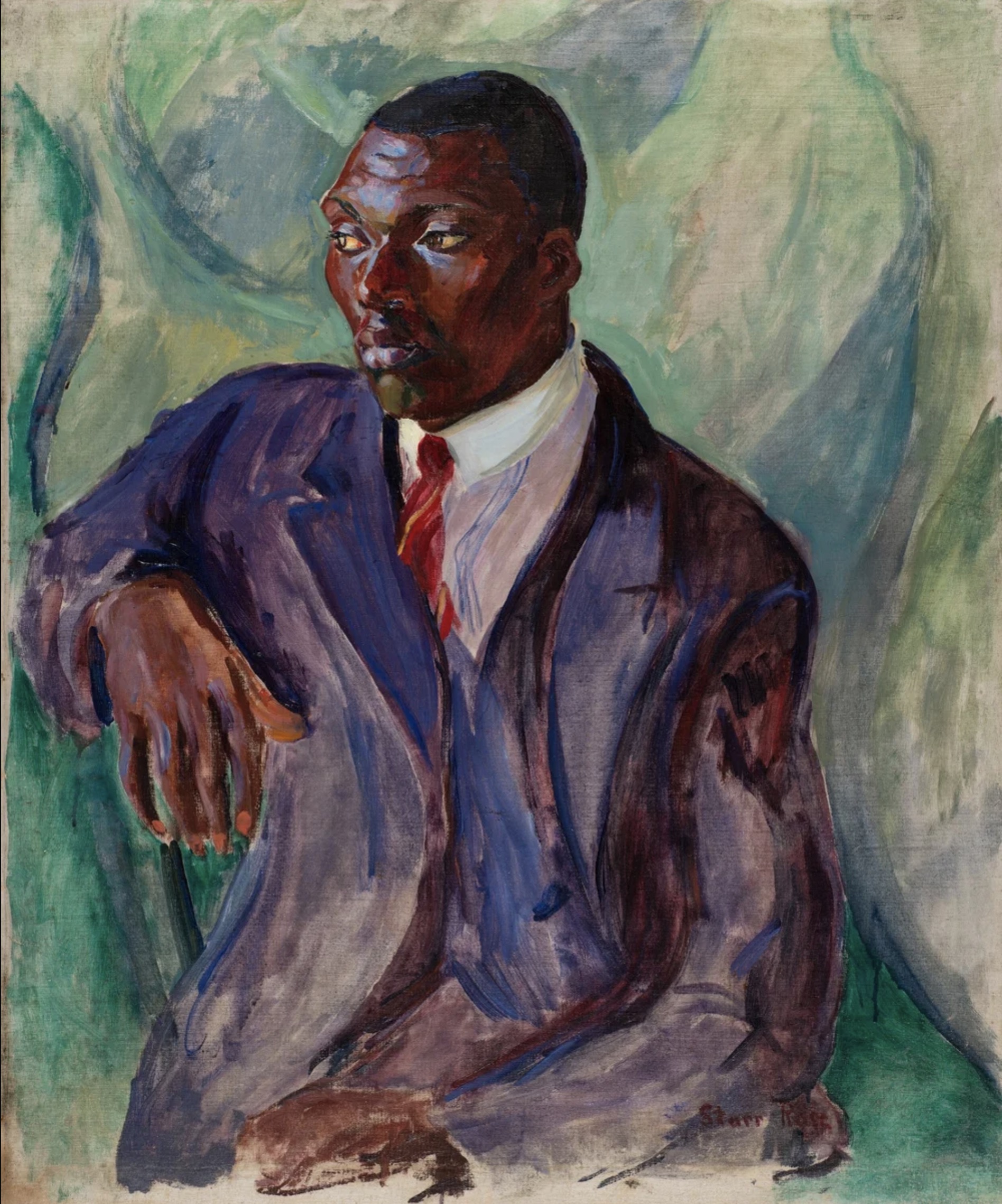
As remarkable and important as the Water’s Edge Museum collection of Ruth Starr Rose paintings and prints may be, its provenance is even more so. Dating back to a time when women had just recently won their right to vote and when Jim Crow laws sought to deny all human rights to African-Americans, Rose – a white woman – created, as she put it, “a record of the life of Negroes of the Eastern Shore. It had never been done,” she wrote, “and is still unique in the annals of art.”

Bernard Moaney as a duck hunter, 1931

While art depicting people of color is no longer “unique” to this collection at the museum located on the Tred Avon’s edge in Oxford, it most likely was the case in 1933 when she wrote about her work. Moreover, it’s hard to imagine that anyone else could have achieved such a legacy. In the early decades of the 20th Century it was rare for black artists or women artists of any color to gain much notice. And her access to an isolated community with every reason to mistrust white strangers is itself remarkable. There were black artists whose success at the time was hard-earned – from Jacob Lawrence in fine art to Paul Robeson in performing arts – they won their notoriety in metropolitan capitals of the United States, principally New York City.

By comparison, Rose, the daughter of staunch Wisconsin abolitionists, won the trust of all-black communities of Talbot County at a time when the Eastern Shore – before any Bay Bridge was even dreamed of – was a geographic backwater. Yet she made friends with residents of The Hill in Easton, the historic neighborhood of free African-Americans dating back before the Civil War, as well as Unionville and Copperville settled by veterans of the war that won their emancipation.

Rose attended their AME churches regularly and developed her appreciation of spirituals performed by people she regarded as friends and neighbors. Among the oil portraits she painted were those of Isaac Copper, namesake of the founding family of the village bearing his surname, and Bernard Moaney, whose descendant, George Moaney, narrates the five-minute video “The Afterglow of Ruth Starr Rose” by Talbot Spy that can be seen on the Water’s Edge website, You Tube or talbotspy.org. He’s also a founding member and genealogical adviser to the museum.

Even in major museums of the world, George Moaney notes, “You don’t see a black person in their paintings except in the background as servants” or, more recently, in portraits of celebrities and political figures, notably Muhammad Ali and President Barack Obama. Before 2015, when the Rose collection surfaced, “Our family didn’t even know these images existed.” The unveiling of the works by Rose (1887-1965) marked, he said, “the first time I had seen on the Eastern Shore black and white people coming together for a cultural event.”

Of her 1933 color serigraph “Jonah and the whale,” featured four years later at the Paris International Exposition, Rose wrote: “Long ago the slaves sang, ‘If the Lord delivered Jonah from the belly of the whale, He will deliver me.’ And these words came too: The Negro race has been delivered from dangers and torments worse than Jonah knew. They have been given a vision of the freedom that can finally be complete.”

But there is much more to see and experience at the Water’s Edge Museum. In its special exhibits gallery, “Black Watermen in the Chesapeake” opens later this month. In the hallway just outside, pause to view “Victoria Park as a Civil Right.” In 1848, about a decade into her 63 years and seven months reign – surpassed only by the 70-year monarchy of Elizabeth II – Queen Victoria granted an “urban botanical garden” for the people of Antigua and Barbuda, part of the British Empire until 1981. The garden, she wrote, serves as open space “for the healthful enjoyment of air and space” for the people of the Caribbean island colony – now a nation.

Be sure, then, to step outside to the Water’s Edge botanical garden. Replete with flowers, plus basil, bell pepper, cucumber and tomato plants, the fruits of which are composted. Besides the staff, the garden is tended, in part, by visiting elementary to middle school children who “learn about environmental justice that is denied to those who live in food desert neighborhoods,” said Sara Park, co-director of Water’s Edge along with Ja’lyn Hicks.

Water’s Edge was awarded a certificate of recognition from the Talbot County Council for the “pictorial history and artifacts on display [portraying] a resilient people who lived their lives, and loved and fought for their country and continued to forge ahead, despite the obstacles and hardships faced.” Council member Keasha Haythe, who had attended the museum’s anniversary celebration earlier in February, commented on the recognition: “Thank you for telling these stories. Having a grandfather who was a waterman, it’s important to tell stories of the heritage, history, and diversity that we have in Talbot County.”

Coincidentally or not, this occurred at the same council session in which a motion to rescind the county’s declaration supporting the goals of diversity, equity and inclusion (DEI) was defeated. However, following Trump administration threats to deny federal funding for expansion of the Easton Airport, the council voted in June to delete all mention of DEI goals in its official statements.

Isaac Copper in a suit, 1931

Nevertheless, Kay Brown, the museum’s assistant director, continues her work as manager of the Middle Passage Port Marker Project. Oxford is the only UNESCO-documented Middle Passage port on the Eastern Shore with no sign declaring that this is where slave ships docked to deliver its human-bondage cargo for sale. It’s a distinction shared in part just across the Tred Avon River where the Bellevue Passage Museum is planning and raising funds to build a space to tell the story of one of the country’s oldest African-American waterfront communities, which became self-sufficient following the Civil War abolition of slavery. The goal is to add on to one of the few remaining historic buildings available, located next to the Oxford-Bellevue Ferry dock. For now, the museum is a virtual one where you can view photos, artifacts and documentation of Bellevue’s own water’s edge past. In partnership with the museum in Oxford, the two would comprise a ferry-linked match in presenting an immersive educational and heritage tourism experience.

***
For more on slavery to self-sufficiency and the Eastern Shore’s witness to both, the Harriet Tubman Freedom Center in Cambridge is exhibiting “Harriet: A Taste of Freedom” through Sept. 30. Curated by Larry Poncho Brown, a Baltimore-based artist, through interpretive works by 40 artists whose visions know no bounds as they are both local and international. The art ranges from portraiture to abstract imagery. In that sense, it’s almost as varied as Tubman’s remarkable life’s work – starting as a runaway slave herself who returned time and again to free family and other fellow slaves in Dorchester County to freedom at least as far north as Philadelphia. And she literally fought for freedom in the Civil War, having recently been promoted posthumously to the rank of general.

While you’re at it, and especially if you haven’t already visited, drive a few miles out of town to the Harriet Tubman Underground Railroad National Historical Park. The visitors center there serves both as a stand-alone attraction with exhibits and films changing from time to time with the goal of orientation as a gateway to the multi-state Harriet Tubman Underground Railroad Scenic Byway. Tubman is quoted as saying, “I never ran my train off the track and I never lost a passenger.”

FROM RUTH STARR ROSE TO HARRIET TUBMAN

Water’s Edge Museum, 101 Mill St., Oxford. watersedgemuseum.org; Bellevue Passage Museum, online only bellevuepassage.org
Also, “Harriet: A Taste of Freedom,” Harriet Tubman Freedom Center, 3030 Center Dr., Cambridge, through Sept. 30 (possibly extended through December); harriettubmanfreedomcenter.com; Harriet Tubman Underground Railroad Visitors Center, 4068 Golden Hill Rd., Church Creek, nps.gov/htu

Steve Parks is a retired New York arts critic and editor now living in Easton.


The Spy Newspapers may periodically employ the assistance of artificial intelligence (AI) to enhance the clarity and accuracy of our content.

Filed Under: 1A Arts Lead

Spy Review: ‘Edge of Your World’ and More at AAM, by Steve Parks

August 22, 2025 by Steve Parks

“To the Edge of Your World” is the intriguing title of a new exhibition by Anita Groener at the Academy Art Museum where she was its 2024 artist-in-residence. But in my initial walkthrough at the opening reception on Saturday, Aug. 16, I found the show – consisting of delicate constructs (I hesitate to call them sculptures) and drawings punctuated by a checkerboard gouache on paper – visually underwhelming. But my first impression was devoid of context aside from the brief wall-label introduction, which mentioned another premiere that day – this of an accompanying animated video, “Shelter,” inspired by highly personal narratives of residents at the Talbot Interfaith Shelter homes on Goldsborough Street in Easton. 

Context makes all the difference in this exhibit of works by the Dutch-born and now Ireland-based artist. Here, Groener deploys appropriately common materials – twigs, cardboard and paper – to reflect the edgy themes suggested in the title: the everyday impact on those directly or indirectly affected by conflict, migration and remembrance of what is left behind as well as trepidation about what lies ahead. At the reception, “Shelter,” the stop-motion animation by Groener in collaboration with documentary filmmaker Matt Kresling in partnership with TIS was shown on a wide screen to a full-capacity audience in the museum’s auditorium. During the run of the exhibition through Oct. 26 visitors can view up close on a video screen in the lobby.

One of the themes that instantly came to my mind as I entered the museum’s Lederer Gallery was “Shelter,” a piece by the same name that looked like anything but. Rather, it resembles a series of cages for imprisoned migrants like those in some border-state detention facilities and on Florida’s notorious Alligator Alley. A series of small drawings bookended by a pair of larger gouache images incorporating bits of twine enigmatically titled “At the Still Point of the Turning World” and “I am Here Because You Are There” leands you toward the gallery back wall lined with tiny stick-constructed objects resembling baby cribs or tree houses, some sprouting leafy saplings and others inhabited by human stick figures. Stick objects on a long table seem to be waiting for assembly into something more than the sum of their parts. We can only guess what.  

Anita Groener


Nearby, you are invited to leave written comments about what you have seen. But before you do, check at least a few segments of the animated “Shelter” video for the context I was lacking at first. You’re not expected to stand through the full half hour in front of the screening of “Shelter,” which runs in loops during museum hours. The imagery constructs and then deconstructs rectangular stands of sticks amid a growing gathering of humans while at other times forming a patch of trees blowing in the wind. Each such scene is accompanied by vocal recordings of TIS residents telling how they became homeless – each very relatable in the sense that – as the saying goes – “there but for the grace of God [or whomever] go I.” Death of a parent or spouse, loss of employment after 22 years, addiction to pain killers after an accident or by self-medication, whether by alcohol or drugs. Each story is separated by photographic images from the artist’s past, usually including a baby or young child and a parent or other relative.

After viewing a few of these vignettes, return to Anita Groener’s exhibit to see what you may have missed at first glance. I missed a lot. But that’s just me.  Maybe you’ll be more intuitive. 

***
While you’re at the museum, walk across the hall to the Healy Gallery for “Fields, Voids, and Translations,” a show of works on paper and textiles by Piper Shepard. A Baltimore-based artist, Shepard specializes in large-scale works – she calls it “architectural scale” – such as weavings that mimic botanical or even celestial imagery. My favorite was “Soft Light Shifting,” a handcut lunar graphic that casts a full-moon shadow on the wall a foot or so behind it, bringing to mind a solar eclipse if you’re at the right place and time for such an event. Three squarish black-and-white prints on paper offer “Textile Translations” from fabric to art on the far wall from the moon. 

In the hallway Atrium between the AAM’s main galleries, stop long enough to take in and contemplate Anne Lindbergh’s commissioned site-specific piece called “seen and unseen.” The most easily “seen” portion are three drawings in parallel lines of complementary colors. These  reflect shades that are largely “unseen” until you stand against the north wall of the natural-light Atrium and look up through an opening toward the second-story ceiling. A luminous sculpture of chromatic threads creates a rainbow effect in earth-and-sky hues that can be seen both above and below. But you’ll  need to climb the stairs to the upper hallway gallery and stroll back to the far wall to discern whether the colors take on a different shade from on high. See for yourself.

ART, ANIMATION, ATRIUM & FIBER IMAGERY

Anita Groener’s “To the Edge of Your World” and “Shelter” video, through Oct. 26; Piper Shepard’s “Fields, Folds, and Translations, through Oct. 12; Anne Lindbergh’s “seen and unseen” installation, through the fall of 2026, all at Academy Art Museum, 106 South St., Easton, Tuesdays-Sundays, free admission, academyartmusuem.org 

Steve Parks is a retired New York arts critic now living in Easton.
 

The Spy Newspapers may periodically employ the assistance of artificial intelligence (AI) to enhance the clarity and accuracy of our content.

Filed Under: 1A Arts Lead

Joe Holt’s ‘First Friday’ Finale – For Now by Steve Parks

July 23, 2025 by Steve Parks

“The Greatest Songwriters of the 20th Century” brings to mind – at least to music lovers of a certain age – “The Great American Songbook” of mostly pre-World War II standards by such artists as Irving Berlin, George Gershwin, Cole Porter, Hoagy Carmichael and many other unforgettable composers and performers. But as interpreted in concert by a married duo–vocalist Sharon Sable and guitarist Shawn Qaissaunee – the playlist expands to include Bob Dylan, The Beatles, Stevie Wonder, and Carole King, to name a few. 

But for “First Friday” regulars of The Mainstay in Rock Hall, the name that draws their attention each month is piano accompanist extraordinaire Joe Holt. So to his many Mid-Shore fans, First Friday, Aug. 1, is a must-see calendar date. Thereafter, Holt will be taking a sabbatical from his monthly Kent County gig. 

He won’t, however, be taking time off from performing altogether. “I’ll be taking a break for a while to reset and refresh,” Holt said in a phone interview.  He’s also in demand in upstate Wilmington, home to his Friday night guest stars Sable and Qaissaunee, as well as at nightspots in and around D.C. 

Joe Holt, Sharon Sable and Shawn Qaissaunee

For 10 years, beginning on Memorial Day, 2016, Holt has been a mainstay – forgive the pun – at The Mainstay, which proclaims itself “The Home of Musical Magic.” Some of that magic began with that first holiday Monday night, later  known alliteratively as “Mainstay Mondays.”

“I thought I’d lost my hearing,” Holt recalls, when he was offered a regular slot for 15 weeks that stretched into five years. As an accompanist by his own preference, he often invited young local artists a chance to showcase their work enhanced by Holt’s piano versatility. No matter the genre, tempo, or style – he could play it.

Holt became so popular that Mainstay’s new (at the time) artistic director Matt Mielnick suggested moving from Mondays to a first-of-the-month Friday night series, which has now rounded out Holt’s tenure at Mainstay to a full decade. The move to a TGIF weekend-opener slot also gave him the opportunity to spotlight broader regional headliners and, in some cases, recording artists with a national following.

His series has run the musical gamut from jazz to soul and classical to country. And rock ’n’ roll too. (Rap, not so much.) His guest artists have included, for instance, Kevin Short, a Morgan State University graduate and a Metropolitan Opera bass-baritone; Paula Johns, a jazz chanteuse and cabaret singer specializing in Great American Songbook favorites; Billy West, a voice actor (“Bugs Bunny,” “Ren & Stimpy” to name a few credits) and singer-songwriter/guitarist who ranges from soul to rockabilly with a dose of comic relief; plus The Midiri Brothers, a couple of Holt’s high school buddies from New Jersey who form a clarinet-and-xylophone jazz duo.

Yes, we told you Joe Holt’s guest stars run the gamut – including locally. Songwriter and pianist Stephanie LaMotte, besides touring globally and performing in “33 Variations,” a play about Beethoven’s life and music, performs for the Chester River Choir and is music director and choirmaster for Emmanuel Episcopal Church in Chestertown, where she now lives. 

To hear Holt talk about himself and his career is more like listening to rave reviews on the virtuosity of each invited guest he accompanies. “If I could do just one thing in my life in music,” he says earnestly, “it’s to be the best accompanist I can be. The stage belongs to my guest artists when I invite them to play up front. And that’s what I’m best at. I can pull it off.”

Holt leaves it to others to speak about what he brings to the stage behind the performers he accompanies:

Beth McDonald, a singer-songwriter who co-wrote and performed in a tribute to Peggy Lee show and appears in jazz festivals and concert tours of American standards and some of her own songs, calls Holt her longtime accompanist and collaborator. They have performed together at The Mainstay, the Stoltz Room in Easton’s Avalon Theater and other venues. 

“He’s the most in-tune accompanist I have ever encountered,” McDonald says, “and not just because he hits the right notes – ha-ha – but because he is able to meet those who share the stage with him exactly where they are. He isn’t thrown off by switching genres or trying new arrangements. Musically speaking, he takes the hand of the one he’s accompanying and together they find that sacred place of connection with their audience. It’s a beautiful thing.”

Whether or not you can make it to the “First Friday” concert (Aug. 1) before he takes a break, you can catch him here and there in the next few months, including the “Blossom Dearie Project” tour promoting “Once Upon a Summertime,” an album of the late singer’s music performed by Sharon Sable and Joe Holt. The upcoming concerts, besides Friday’s at The Mainstay, are the Elana Byrd’s Jazz Series in Annapolis, Sept. 28, and “Broadway’s Jazz Gems of the Great American Songbook” in Lewes, Delaware, Nov. 2. (Elana is the widow of jazz bassist Joe Byrd, the younger brother of guitarist Charlie Byrd.)

Meanwhile, you can keep up with Holt’s appearances hither and yon in Delaware and D.C. and anywhere else he may pop up on joeholtsnotes.com.

The Last Joe Holt ‘First Friday’ (For Now)

8 p.m. Aug. 1, The Mainstay, 5753 N. Main St., Rock Hall. Upcoming concerts with singer Sharon Sable, Sept. 28, Elana Byrd’s Jazz Series, Annapolis. (Call 410-626-9796); and in Lewes, Delaware, Nov. 2. (Also check joeholtsnotes.com for details on any of these shows.)

Steve Parks is a retired arts critic and editor now living in Easton.


The Spy Newspapers may periodically employ the assistance of artificial intelligence (AI) to enhance the clarity and accuracy of our content.

Filed Under: 1A Arts Lead

  • 1
  • 2
  • 3
  • …
  • 40
  • Next Page »

Copyright © 2026

Affiliated News

  • The Cambridge Spy
  • The Talbot Spy

Sections

  • Arts
  • Culture
  • Ecosystem
  • Education
  • Health
  • Local Life and Culture
  • Spy Senior Nation

Spy Community Media

  • About
  • Subscribe
  • Contact Us
  • Advertising & Underwriting

Copyright © 2026 · Spy Community Media Child Theme on Genesis Framework · WordPress · Log in