

Happy Mystery Monday! Can you guess what is pictured in photo #1?

The answer to last week’s mystery is the American five-lined skink, Plestiodon fasciatus, pictured in photo #2.
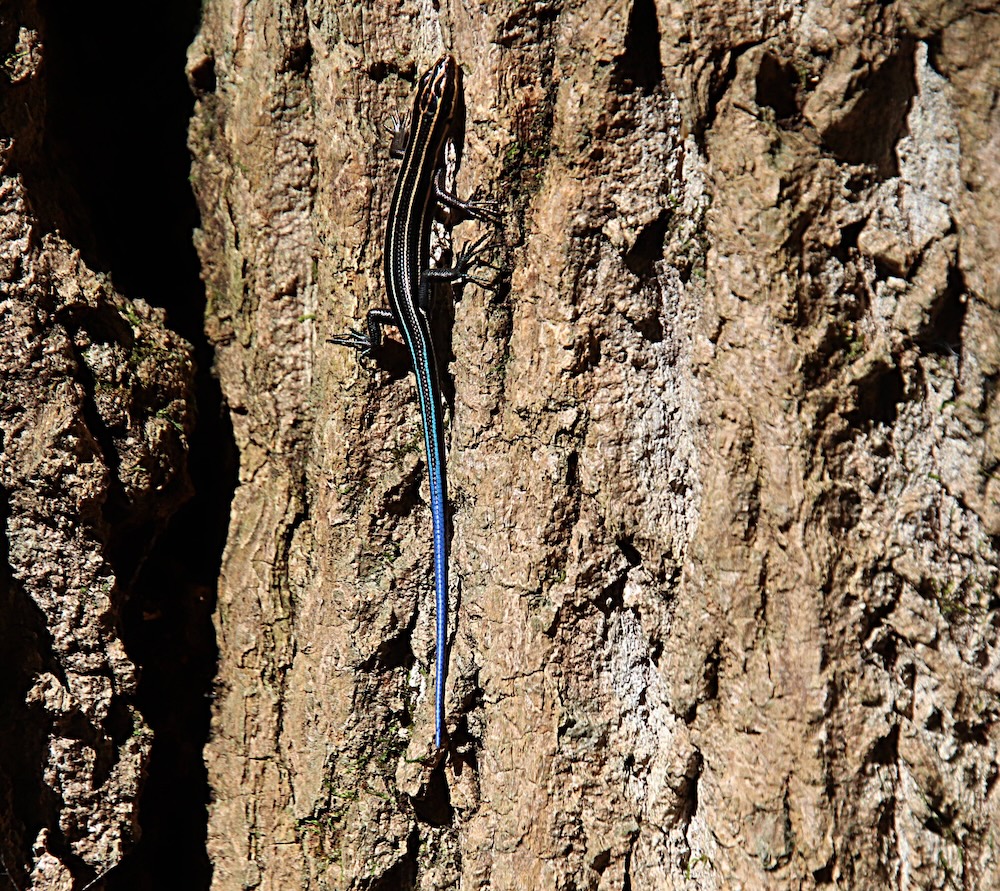
The American five-lined skink is a familiar backyard reptile found throughout Maryland, especially on the Coastal Plain. (Note: The blue-tailed skink is from Australia, and the five-lined skink is African. This species is specifically the American five-lined skink.) Juveniles are easy to recognize with their glossy black bodies, five pale stripes, and brilliant blue tails. Adult males lose much of this coloring and become olive or tan with vivid red-orange jaws during breeding season, often being confused with the broad-headed skink, Plestiodon laticeps, a closely related species with which it shares habitat.
These lizards prefer moist but not wet woodlands and are often seen foraging on logs, porches, and even in trees. On sunny days, they bask briefly before darting back to cover. If threatened, they can drop their tails, which continue to wriggle and distract predators while the skink escapes; a new tail will eventually grow back. The bright blue tail not only draws predators away from the head but also warns of the skink’s toxicity if eaten.
Females lay 15–18 eggs in secluded spots beneath rotting logs or boards from May to July. They demonstrate a high level of parental care, and curl protectively around their clutch until hatching. In some communal nests females are known to alternate foraging and guarding of the eggs; this also allows them to warm the eggs by basking in the sun before returning. After hatching, the young soon leave the nest to fend for themselves and become sexually mature in two or three years. They feed primarily on invertebrates such as insects and spiders. Common five-lined skinks can live up to six years and remain one of the most common and fascinating reptiles of our backyards.
Mystery Monday is sponsored by the Spy Newspapers and Adkins Arboretum.
Clark Bjorke says
This one is river oats
Mary Ann Brown says
Northern sea oats
PAULA REEDER says
Looks like Oat Grass
Kathleen Khk Knust says
Marshy reeds